Q23Molecular orbital theory of diatomic speciesTRANSCRIBED
The species having bond order different from that in CO is
- A
- B
- C
- D
The 22 Chemistry questions of JEE Advanced 2007 Paper 1, numbered across the whole paper. Pick an answer on any question to check it against the key. Free to read, nothing to download.
The species having bond order different from that in CO is
Among the following, the paramagnetic compound is
Extraction of zinc from zinc blende is achieved by
electrolytic reduction
roasting followed by reduction with carbon
roasting followed by reduction with another metal
roasting followed by self-reduction
In the following reaction,
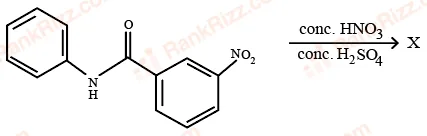
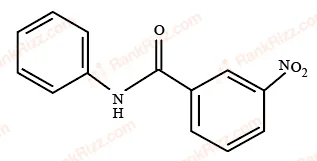
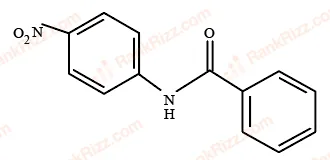
the structure of the major product 'X' is
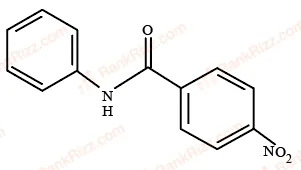
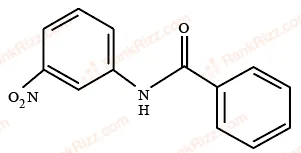
The reagent(s) for the following conversion,

is/are
alcoholic KOH
alcoholic KOH followed by
aqueous KOH followed by
The numberof structural isomers for is
3
4
5
6
The percentage of p-character in the orbitals forming P—P bondsin is
25
33
50
75
When 20 g of naphthoic acid is dissolved in 50 g of benzene = 1.72 K kg mol), a freezing point depression of 2 K is observed. The van't Hoff factor (i) is
0.5
1
2
3
The value of for a reaction is
(Given : = -54.07 kJ mol, = 10 JK mol and R = 8.314 JK mol; )
5
10
95
100
STATEMENT-1 : Boron always forms covalent bond.
because
STATEMENT-2: The small size of favours formation of covalent bond.
Statement-1 is True, Statement-2 is True; Statement-2 is a correct explanation for Statement-1
Statement-1 is True, Statement-2 is True; Statement-2 is NOT a correct explanation for Statement-1
Statement-1 is True, Statement-2 is False
Statement-1 is False, Statement-2 is True
STATEMENT-1: In water, orthoboric acid behaves as a weak monobasic acid.
because
STATEMENT-2: In water, orthoboric acid acts as a proton donor.
Statement-1 is True, Statement-2 is True; Statement-2 is a correct explanation for Statement-1
Statement-1 is True, Statement-2 is True; Statement-2 is NOT a correct explanation for Statement-1
Statement-1 is True, Statement-2 is False
Statement-1 is False, Statement-2 is True
STATEMENT-1: p-Hydroxybenzoic acid has a lower boiling point than o-hydroxybenzoic acid.
because
STATEMENT-2 : o-Hydroxybenzoic acid has intramolecular hydrogen bonding.
Statement-1 is True, Statement-2 is True; Statement-2 is a correct explanation for Statement-1
Statement-1 is True, Statement-2 is True; Statement-2 is NOT a correct explanation for Statement-1
Statement-1 is True, Statement-2 is False
Statement-1 is False, Statement-2 is True
STATEMENT-1 : Micelles are formed by surfactant molecules above the critical micellar concentration (CMC).
because
STATEMENT-2 : The conductivity of a solution having surfactant molecules decreases sharply at the CMC.
Statement-1 is True, Statement-2 is True; Statement-2 is a correct explanation for Statement-1
Statement-1 is True, Statement-2 is True; Statement-2 is NOT a correct explanation for Statement-1
Statement-1 is True, Statement-2 is False
Statement-1 is False, Statement-2 is True
Argon is used in are welding because of its
low reactivity with metal
ability to lower the melting point of metal
flammability
high calorific value
The structure of is
linear
planar
pyramidal
T-shaped
and are expected to be
oxidizing
reducing
unreactive
strongly basic
The total number of moles of chlorine gas evolved is
0.5
1.0
2.0
3.0
If the cathode is a Hg electrode, the maximum weight (g) of amalgam formed from this solution is
200
225
400
446
The total charge (coulombs) required for complete electrolysis is
24125
48250
96500
193000
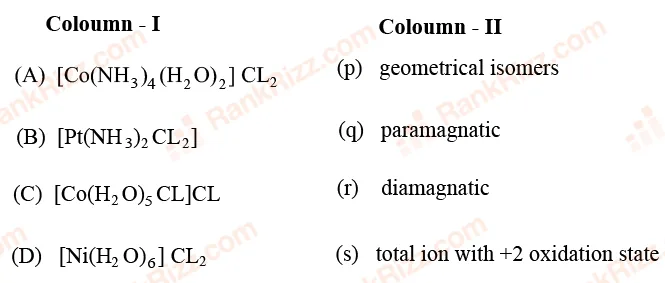
Match the complexes in Column I with their properties listed in Column II. Indicate your answer by darkening the appropriate bubbles of the matrix given in the ORS.
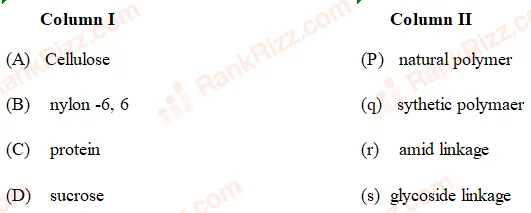
Match the chemical substances in Column I with type of polymers/type of bonds in Column II. Indicate your answer by darkening the appropriate bubbles of the matrix given in the ORS.
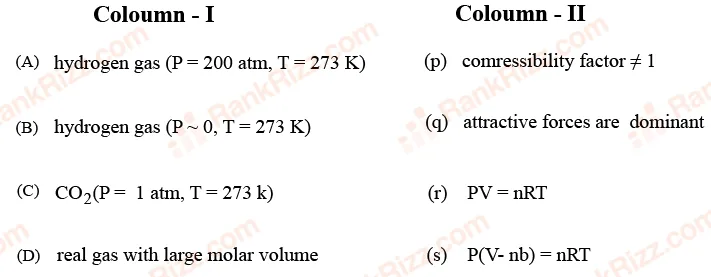
Match gases under specified conditions listed in Column I with their properties/laws in Column II. Indicate your answer by darkening the appropriate bubbles of the matrix given in the ORS.