RankRizzStart free

JEE Advanced 2007 Paper 1 Question Paper

All 66 questions of JEE Advanced 2007 Paper 1, in the order they were asked. Pick an answer on any question to check it against the key. Free to read, nothing to download.

Questions

66

Physics · Chemistry · Mathematics

Answer key

66

questions with a checked key

Under review

0

key not yet trusted

Price

Free

no sign-up

Physics

Q1JEE ADVANCED 2007 · PAPER 1Meter bridgeTRANSCRIBED

A resistance of 2 Ω is connected across one gap of a metre-bridge (the length of the wire is 100 cm) and an unknown resistance, greater than 2 Ω, is connected across the other gap. When these resistances are interchanged, the balance point shifts by 20 cm. Neglecting any corrections, the unknown resistance is

  1. A

    3 Ω

  2. B

    4 Ω

  3. C

    5 Ω

  4. D

    6 Ω

Q2JEE ADVANCED 2007 · PAPER 1Reflection and plane mirrorsTRANSCRIBED

In an experiment to determine the focal length (f) of a concave mirror by the u-v method, a student places the object pin A on the principal axis at a distance x from the pole P. The student looks at the pin and its inverted image from a distance keeping his/her eye in line with PA. When the student shifts his/her eye towards left, the image appears to the right of the object pin. Then,

  1. A

    x < f

  2. B

    f < x < 2f

  3. C

    x = 2f

  4. D

    x > 2f

Q3JEE ADVANCED 2007 · PAPER 1Connected bodies, pulleys and constraint relationsTRANSCRIBED

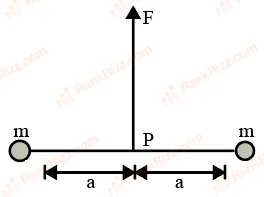
Two particles of mass m each are tied at the ends of a light string of length 2a. The whole system is kept on a frictionless horizontal surface with the string held tight so that each mass is at a distance ‘a’ from the center P (as shown in the figure). Now, the mid-point of the string is pulled vertically upwards with a small but constant force F. As a result, the particles move towards each other on the surface. The magnitude of acceleration, when the separation between them becomes 2x, is

  1. A

  2. B

  3. C

  4. D

Q4JEE ADVANCED 2007 · PAPER 1Electric flux and Gauss's lawTRANSCRIBED

A long, hollow conducting cylinder is kept coaxially inside another long, hollow conducting cylinder of larger radius. Both the cylinders are initially electrically neutral.

  1. A

    A potential difference appears between the two cylinders when a charge density is given to the inner cylinder

  2. B

    A potential difference appears between the two cylinders when a charge density is given to the outer cylinder

  3. C

    No potential difference appears between the two cylinders when a uniform line charge is kept along the axis of the cylinders

  4. D

    No potential difference appears between the two cylinders when same charge density is given to both the cylinders

Q5JEE ADVANCED 2007 · PAPER 1Electric flux and Gauss's lawTRANSCRIBED

Consider a neutral conducting sphere. A positive point charge is placed outside the sphere. The net charge on the sphere is then,

  1. A

    negative and distributed uniformly over the surface of the sphere

  2. B

    negative and appears only at the pointon the sphere closest to the point charge

  3. C

    negative and distributed non-uniformly over the entire surface of the sphere

  4. D

    zero

Q6JEE ADVANCED 2007 · PAPER 1RC circuits: charging and dischargingTRANSCRIBED

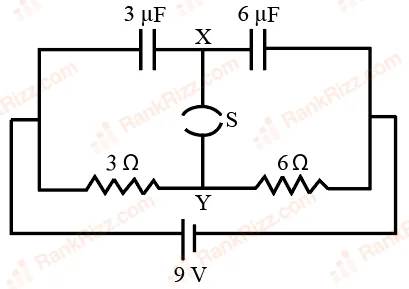
A circuit is connected as shown in the figure with the switch S open. When the switch is closed, the total amount of charge that flows from Y to X is 

  1. A

    0

  2. B

    54 C

  3. C

    27 C

  4. D

    81 C

Q7JEE ADVANCED 2007 · PAPER 1Prism: deviation and dispersionTRANSCRIBED

A ray of light traveling in wateris incident on its surface open to air. The angle of incidence is , which is less than the critical angle. Then there will be

  1. A

    only reflected ray and no refracted ray

  2. B

    only a refracted ray and no reflected ray

  3. C

    a reflected ray and a refracted ray and the angle between them would be less than

  4. D

    a reflected ray and a refracted ray and the angle between them would be greater than

Q8JEE ADVANCED 2007 · PAPER 1Nuclear fission, fusion and Q-valueTRANSCRIBED

In the options given below, let E denote the rest mass energy of a nucleus and n aneutron. The correct option is

  1. A

    E\left(_{92}^{236}U\right) &gt; E\left(_{53}^{137}I\right) + E\left(_{39}^{97}Y\right) + 2E(n)

  2. B

    E\left(_{92}^{236}U\right) &lt; E\left(_{53}^{137}I\right) + E\left(_{39}^{97}Y\right) + 2E(n)

  3. C

    E\left(_{92}^{236}U\right) &lt; E\left(_{56}^{140}Ba\right) + E\left(_{36}^{94}Kr\right) + 2E(n)

  4. D

Q9JEE ADVANCED 2007 · PAPER 1Hydrogen spectrum and spectral seriesTRANSCRIBED

The largest wavelength in the ultraviolet region of the hydrogen spectrum is 122 nm. The smallest wavelength in the infrared region of the hydrogen spectrum (to the nearest integer) is

  1. A

    802 nm

  2. B

    823 nm

  3. C

    1882 nm

  4. D

    1648 nm

Q10JEE ADVANCED 2007 · PAPER 1Work done by constant and variable forcesTRANSCRIBED

STATEMENT-1
A block of mass m starts moving on a rough horizontal surface with a velocity v. It stops due to friction between the block and the surface after moving through a certain distance. The surface is now tilted to an angle of with the horizontal and the same block is made to go up on the surface with the same initial velocity v. The decrease in the mechanical energy in the second situation is smaller than thatin thefirst situation.
because
STATEMENT-2
The coefficient of friction between the block and the surface decreases with the increase in the angle of inclination.

  1. A

    Statement-1 is True, Statement-2 is True; Statement-2 is a correct explanation for Statement-1

  2. B

    Statement-1 is True, Statement-2 is True; Statement-2 is NOT a correct explanation for Statement-1

  3. C

    Statement-1 is True, Statement-2 is False

  4. D

    Statement-1 is False, Statement-2 is True

Q11JEE ADVANCED 2007 · PAPER 1Motion of centre of mass, momentum conservation and explosionsTRANSCRIBED

STATEMENT-1
In an elastic collision between two bodies, the relative speed of the bodies after collision is equal to the relative speed before the collision.
because
STATEMENT-2
In anelastic collision, the linear momentum of the system is conserved.

  1. A

    Statement-1 is True, Statement-2 is True; Statement-2 is a correct explanation for Statement-1

  2. B

    Statement-1 is True, Statement-2 is True; Statement-2 is NOT a correct explanation for Statement-1

  3. C

    Statement-1 is True, Statement-2 is False

  4. D

    Statement-1 is False, Statement-2 is True

Q12JEE ADVANCED 2007 · PAPER 1Reflection and plane mirrorsTRANSCRIBED

STATEMENT-1
The formula connecting u, v and f for a spherical mirror is valid only for mirrors whosesizes are very small compared to their radii of curvature.
because
STATEMENT-2
Lawsof reflection are strictly valid for plane surfaces, but not for large spherical surfaces.

  1. A

    Statement-1 is True, Statement-2 is True; Statement-2 is a correct explanation for Statement-1

  2. B

    Statement-1 is True, Statement-2 is True; Statement-2 is NOT a correct explanation for Statement-1

  3. C

    Statement-1 is True, Statement-2 is False

  4. D

    Statement-1 is False, Statement-2 is True

Q13JEE ADVANCED 2007 · PAPER 1Photoelectric effect and Einstein's equationTRANSCRIBED

STATEMENT-1
If the accelerating potential in an X-ray tube is increased, the wavelengths of the characteristic X-rays do not change.
because
STATEMENT-2
Whenanelectron beam strikes the target in an X-ray tube, part of the kinetic energy is converted into X-ray energy.

  1. A

    Statement-1 is True, Statement-2 is True; Statement-2 is a correct explanation for Statement-1

  2. B

    Statement-1 is True, Statement-2 is True; Statement-2 is NOT a correct explanation for Statement-1

  3. C

    Statement-1 is True, Statement-2 is False

  4. D

    Statement-1 is False, Statement-2 is True

Q14JEE ADVANCED 2007 · PAPER 1Rolling with friction, slipping and impulsive forcesTRANSCRIBED

The ratio is

  1. A

    2

  2. B

  3. C

  4. D

Q15JEE ADVANCED 2007 · PAPER 1Angular momentum of particles and rigid bodiesTRANSCRIBED

When disc B is brought in contact with disc A, they acquire a common angular velocity in time t. The averagefrictional torque on one disc by the other during this period is

  1. A

  2. B

  3. C

  4. D

Q16JEE ADVANCED 2007 · PAPER 1Calculus, graphs and approximations used in physicsTRANSCRIBED

The loss of kinetic energy during the above process is

  1. A

  2. B

  3. C

  4. D

Q17JEE ADVANCED 2007 · PAPER 1Ideal gas equation and gas lawsTRANSCRIBED

The piston is now pulled out slowly and held at a distance 2L from the top. The pressure in the cylinder between its top and the piston will then be

  1. A

  2. B

  3. C

  4. D

Q18JEE ADVANCED 2007 · PAPER 1Ideal gas equation and gas lawsTRANSCRIBED

While the piston is at a distance 2L from the top, the hole at the top is sealed. The piston is then released, to a position where it can stay in equilibrium. In this condition, the distance of the piston from the top is

  1. A

  2. B

  3. C

  4. D

Q19JEE ADVANCED 2007 · PAPER 1Multi-step processes and gas-piston-spring systemsTRANSCRIBED

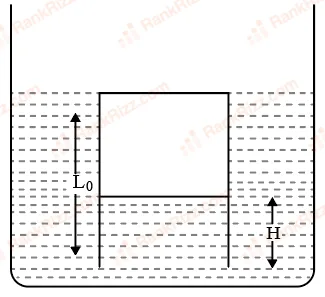
The piston is taken completely out of the cylinder. The hole at the top is sealed. A water tank is brought below the cylinder and put in a position so that the water surface in the tank is at the same level as the top of the cylinder as shown in the figure. The density of the water is . In equilibrium, the height H of the water column in the cylinder satisfies 

  1. A

  2. B

  3. C

  4. D

Q20JEE ADVANCED 2007 · PAPER 1Kepler's laws and planetary motionTRANSCRIBED

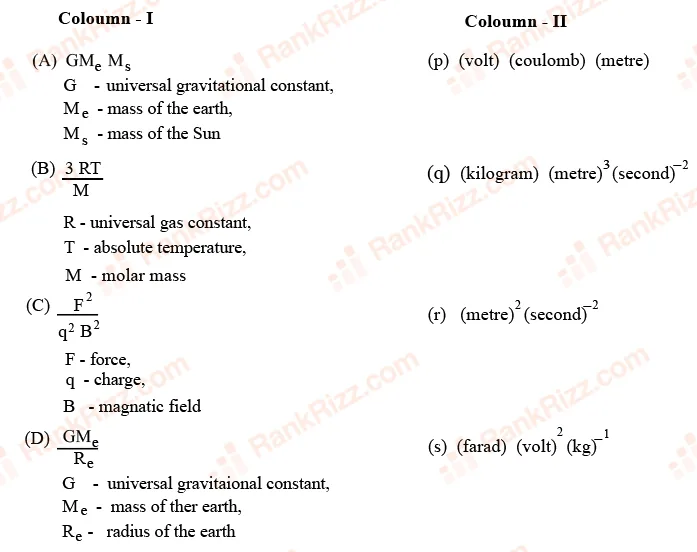
Some physical quantities are given in Column I and some possible SI units in which these quantities may be expressed are given in Column II. Match the physical quantities in Column I with the units in Column II and indicate your answer by darkening appropriate bubbles in the matrix given in the ORS.

Q21JEE ADVANCED 2007 · PAPER 1Electric power and heating effect of currentTRANSCRIBED

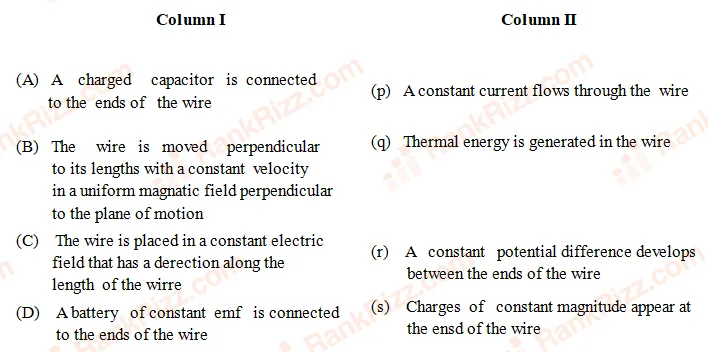
Column I gives certain situations in which a straight metallic wire of resistance R is used and Column II gives some resulting effects. Match the statements in Column I with the statements in Column II and indicate your answer by darkening appropriate bubbles in the matrix given in the ORS.

Q22JEE ADVANCED 2007 · PAPER 1Photoelectric effect and Einstein's equationTRANSCRIBED

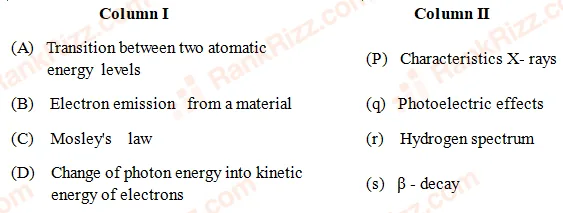
Some laws / processes are given in Column I. Match these with the physical phenomena given in Column II and indicate your answer by darkening appropriate bubbles in the matrix given in the ORS.

Chemistry

Q23JEE ADVANCED 2007 · PAPER 1Molecular orbital theory of diatomic speciesTRANSCRIBED

The species having bond order different from that in CO is

  1. A

  2. B

  3. C

  4. D

Q24JEE ADVANCED 2007 · PAPER 1Molecular orbital theory of diatomic speciesTRANSCRIBED

Among the following, the paramagnetic compound is

  1. A

  2. B

  3. C

  4. D

Q25JEE ADVANCED 2007 · PAPER 1Extraction of Fe, Cu, Zn, Al, Ag and AuTRANSCRIBED

Extraction of zinc from zinc blende is achieved by

  1. A

    electrolytic reduction

  2. B

    roasting followed by reduction with carbon

  3. C

    roasting followed by reduction with another metal

  4. D

    roasting followed by self-reduction

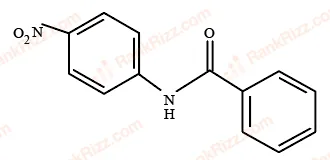
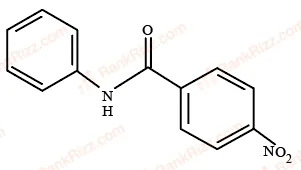
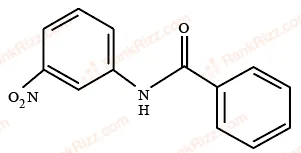
Q26JEE ADVANCED 2007 · PAPER 1Benzene and aromatic hydrocarbons: structure and preparationTRANSCRIBED

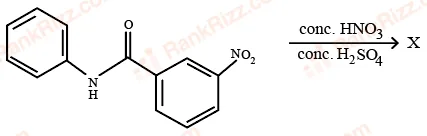
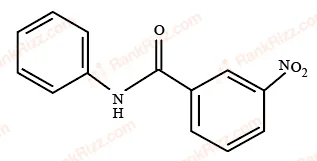
In the following reaction,


the structure of the major product 'X' is

  1. A
  2. B
  3. C
  4. D
Q27JEE ADVANCED 2007 · PAPER 1Classification, functional groups and hybridisation in organic compoundsTRANSCRIBED

The reagent(s) for the following conversion,

is/are

  1. A

    alcoholic KOH

  2. B

    alcoholic KOH followed by

  3. C

    aqueous KOH followed by

  4. D

Q28JEE ADVANCED 2007 · PAPER 1Structural isomerismTRANSCRIBED

The numberof structural isomers for is

  1. A

    3

  2. B

    4

  3. C

    5

  4. D

    6

Q29JEE ADVANCED 2007 · PAPER 1Phosphorus and its compoundsTRANSCRIBED

The percentage of p-character in the orbitals forming P—P bondsin is

  1. A

    25

  2. B

    33

  3. C

    50

  4. D

    75

Q30JEE ADVANCED 2007 · PAPER 1Abnormal molar mass and van't Hoff factorTRANSCRIBED

When 20 g of naphthoic acid is dissolved in 50 g of benzene = 1.72 K kg mol), a freezing point depression of 2 K is observed. The van't Hoff factor (i) is

  1. A

    0.5

  2. B

    1

  3. C

    2

  4. D

    3

Q31JEE ADVANCED 2007 · PAPER 1Gibbs energy and spontaneityTRANSCRIBED

The value of for a reaction is
(Given : = -54.07 kJ mol, = 10 JK mol and R = 8.314 JK mol; )

  1. A

    5

  2. B

    10

  3. C

    95

  4. D

    100

Q32JEE ADVANCED 2007 · PAPER 1Resonance and bond parametersTRANSCRIBED

STATEMENT-1 : Boron always forms covalent bond.
because
STATEMENT-2: The small size of favours formation of covalent bond.

  1. A

    Statement-1 is True, Statement-2 is True; Statement-2 is a correct explanation for Statement-1

  2. B

    Statement-1 is True, Statement-2 is True; Statement-2 is NOT a correct explanation for Statement-1

  3. C

    Statement-1 is True, Statement-2 is False

  4. D

    Statement-1 is False, Statement-2 is True

Q33JEE ADVANCED 2007 · PAPER 1Group 13: general trends and inert pair effectTRANSCRIBED

STATEMENT-1: In water, orthoboric acid behaves as a weak monobasic acid.
because
STATEMENT-2: In water, orthoboric acid acts as a proton donor.

  1. A

    Statement-1 is True, Statement-2 is True; Statement-2 is a correct explanation for Statement-1

  2. B

    Statement-1 is True, Statement-2 is True; Statement-2 is NOT a correct explanation for Statement-1

  3. C

    Statement-1 is True, Statement-2 is False

  4. D

    Statement-1 is False, Statement-2 is True

Q34JEE ADVANCED 2007 · PAPER 1Reactions of carboxylic acidsTRANSCRIBED

STATEMENT-1: p-Hydroxybenzoic acid has a lower boiling point than o-hydroxybenzoic acid.
because
STATEMENT-2 : o-Hydroxybenzoic acid has intramolecular hydrogen bonding.

  1. A

    Statement-1 is True, Statement-2 is True; Statement-2 is a correct explanation for Statement-1

  2. B

    Statement-1 is True, Statement-2 is True; Statement-2 is NOT a correct explanation for Statement-1

  3. C

    Statement-1 is True, Statement-2 is False

  4. D

    Statement-1 is False, Statement-2 is True

Q35JEE ADVANCED 2007 · PAPER 1Properties of colloids and coagulationTRANSCRIBED

STATEMENT-1 : Micelles are formed by surfactant molecules above the critical micellar concentration (CMC).
because
STATEMENT-2 : The conductivity of a solution having surfactant molecules decreases sharply at the CMC.

  1. A

    Statement-1 is True, Statement-2 is True; Statement-2 is a correct explanation for Statement-1

  2. B

    Statement-1 is True, Statement-2 is True; Statement-2 is NOT a correct explanation for Statement-1

  3. C

    Statement-1 is True, Statement-2 is False

  4. D

    Statement-1 is False, Statement-2 is True

Q36JEE ADVANCED 2007 · PAPER 1Group 18: noble gases and xenon compoundsTRANSCRIBED

Argon is used in are welding because of its

  1. A

    low reactivity with metal

  2. B

    ability to lower the melting point of metal

  3. C

    flammability

  4. D

    high calorific value

Q37JEE ADVANCED 2007 · PAPER 1Group 18: noble gases and xenon compoundsTRANSCRIBED

The structure of is

  1. A

    linear

  2. B

    planar

  3. C

    pyramidal

  4. D

    T-shaped

Q38JEE ADVANCED 2007 · PAPER 1Group 18: noble gases and xenon compoundsTRANSCRIBED

and are expected to be

  1. A

    oxidizing

  2. B

    reducing

  3. C

    unreactive

  4. D

    strongly basic

Q39JEE ADVANCED 2007 · PAPER 1Conductance, conductivity and molar conductivityTRANSCRIBED

The total number of moles of chlorine gas evolved is

  1. A

    0.5

  2. B

    1.0

  3. C

    2.0

  4. D

    3.0

Q40JEE ADVANCED 2007 · PAPER 1Conductance, conductivity and molar conductivityTRANSCRIBED

If the cathode is a Hg electrode, the maximum weight (g) of amalgam formed from this solution is

  1. A

    200

  2. B

    225

  3. C

    400

  4. D

    446

Q41JEE ADVANCED 2007 · PAPER 1Conductance, conductivity and molar conductivityTRANSCRIBED

The total charge (coulombs) required for complete electrolysis is

  1. A

    24125

  2. B

    48250

  3. C

    96500

  4. D

    193000

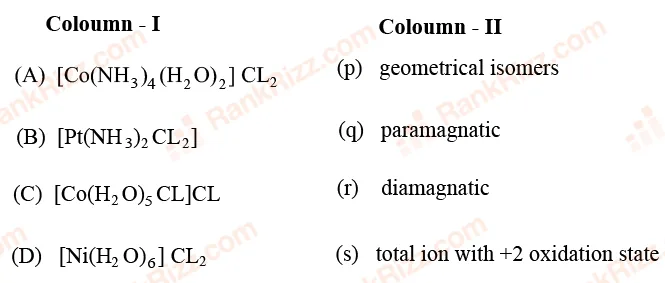
Q42JEE ADVANCED 2007 · PAPER 1Crystal field splitting, CFSE and spectrochemical seriesTRANSCRIBED

Match the complexes in Column I with their properties listed in Column II. Indicate your answer by darkening the appropriate bubbles of the matrix given in the ORS.

Q43JEE ADVANCED 2007 · PAPER 1Classification of polymers and types of polymerisationTRANSCRIBED

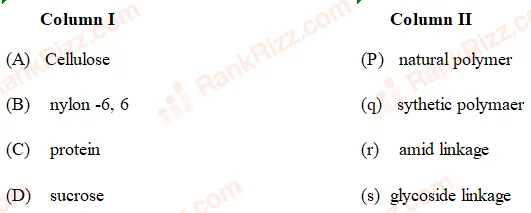
Match the chemical substances in Column I with type of polymers/type of bonds in Column II. Indicate your answer by darkening the appropriate bubbles of the matrix given in the ORS.

Q44JEE ADVANCED 2007 · PAPER 1Real gases, compressibility factor and van der Waals equationTRANSCRIBED

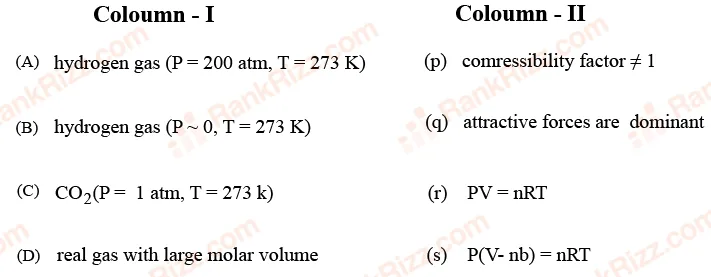
Match gases under specified conditions listed in Column I with their properties/laws in Column II. Indicate your answer by darkening the appropriate bubbles of the matrix given in the ORS.

Mathematics

Q45JEE ADVANCED 2007 · PAPER 1Relation between roots and coefficientsTRANSCRIBED

Let be the roots of the equation and be the roots of the equation . Then the value of r is

  1. A

  2. B

  3. C

  4. D

Q46JEE ADVANCED 2007 · PAPER 1Rate of change of quantitiesTRANSCRIBED

Let f(x) be differentiable on the interval suh that f(1) = 1, and for each x > 0. Then f(x) is

  1. A

  2. B

  3. C

  4. D

Q47JEE ADVANCED 2007 · PAPER 1Conditional probability and multiplication theoremTRANSCRIBED

One Indian and four American men and their wives are to be seated randomly around a circular table. Then the conditional probability that the Indian man is seated adjacent to his wife given that each American manis seated adjacent to his wife is

  1. A

  2. B

  3. C

  4. D

Q48JEE ADVANCED 2007 · PAPER 1Tangents, pair of tangents and chord of contactTRANSCRIBED

The tangent to the curve drawn at the point intersects the line joining the points and

  1. A

    on the left of x = c

  2. B

    on the right of x = c

  3. C

    at no point

  4. D

    at all points

Q49JEE ADVANCED 2007 · PAPER 1Equation of a circle in various formsTRANSCRIBED

equals

  1. A

  2. B

  3. C

  4. D

Q50JEE ADVANCED 2007 · PAPER 1Standard hyperbola and basic propertiesTRANSCRIBED

A hyperbola, having the transverse axis of length , is confocal with the ellipse . Then its equation is

  1. A

  2. B

  3. C

  4. D

Q51JEE ADVANCED 2007 · PAPER 1Scalar triple product and coplanarityTRANSCRIBED

The number of distinct real values of , for which the vectors and are coplanar, is

  1. A

    zero

  2. B

    one

  3. C

    two

  4. D

    three

Q52JEE ADVANCED 2007 · PAPER 1Locus and regions in the Argand planeTRANSCRIBED

A man walks a distance of 3 units from the origin towards the north-east direction. From there, he walks a distance of 4 units towards the north-west direction to reach a point P. Then the position of P in the Argand plane is

  1. A

  2. B

  3. C

  4. D

Q53JEE ADVANCED 2007 · PAPER 1Equations with parameters and trigonometric inequalitiesTRANSCRIBED

The number of solutions of the pair of equations


in the interval is

  1. A

    zero

  2. B

    one

  3. C

    two

  4. D

    four

Q54JEE ADVANCED 2007 · PAPER 1Bayes' theoremTRANSCRIBED

Let be mutually exclusive and exhaustive events with P(H_i) &gt; 0, i = 1, 2, 3, ...., n. Let E be any other event with 0 &lt; P(E) &lt; 1.
STATEMENT-1: P(H_i \mid E) &gt; P(E \mid H_i).P(H_i) for i = 1, 2, ..., n.
because
STATEMENT-2:

  1. A

    Statement-1 is True, Statement-2 is True; Statement-2 is a correct explanation for Statement-1

  2. B

    Statement-1 is True, Statement-2 is True; Statement-2 is NOT a correct explanation for Statement-1

  3. C

    Statement-1 is True, Statement-2 is False

  4. D

    Statement-1 is False, Statement-2 is True

Q55JEE ADVANCED 2007 · PAPER 1Pair of tangents, chord of contact and director circleTRANSCRIBED

Tangents are drawn from the point (17, 7) to the circle .
STATEMENT-1: The tangents are mutually perpendicular.
because
STATEMENT-2: The locus of the points from which mutually perpendicular tangents can be drawn to the givencircle is .

  1. A

    Statement-1 is True, Statement-2 is True; Statement-2 is a correct explanation for Statement-1

  2. B

    Statement-1 is True, Statement-2 is True; Statement-2 is NOT a correct explanation for Statement-1

  3. C

    Statement-1 is True, Statement-2 is False

  4. D

    Statement-1 is False, Statement-2 is True

Q56JEE ADVANCED 2007 · PAPER 1Vector (cross) product and areaTRANSCRIBED

Let the vectors and represent the sides of a regular
hexagon.
STATEMENT-1:
because
STATEMENT-2: and

  1. A

    Statement-1 is True, Statement-2 is True; Statement-2 is a correct explanation for Statement-1

  2. B

    Statement-1 is True, Statement-2 is True; Statement-2 is NOT a correct explanation for Statement-1

  3. C

    Statement-1 is True, Statement-2 is False

  4. D

    Statement-1 is False, Statement-2 is True

Q57JEE ADVANCED 2007 · PAPER 1Sum and difference formulasTRANSCRIBED

Let be an indefinite integral of .
STATEMENT-1 : The function satisfies for all real x.
because
STATEMENT-2: for all real x.

  1. A

    Statement-1 is True, Statement-2 is True; Statement-2 is a correct explanation for Statement-1

  2. B

    Statement-1 is True, Statement-2 is True; Statement-2 is NOT a correct explanation for Statement-1

  3. C

    Statement-1 is True, Statement-2 is False

  4. D

    Statement-1 is False, Statement-2 is True

Q58JEE ADVANCED 2007 · PAPER 1Sums of natural numbers, squares and cubesTRANSCRIBED

The sum is

  1. A

  2. B

  3. C

  4. D

Q59JEE ADVANCED 2007 · PAPER 1Arithmetic progressionTRANSCRIBED

is always

  1. A

    an odd number

  2. B

    an even number

  3. C

    a prime number

  4. D

    a composite number

Q60JEE ADVANCED 2007 · PAPER 1Arithmetic progressionTRANSCRIBED

Which one of the following is a correct statement?

  1. A

    are in A.P. with commondifference 5

  2. B

    are in A.P. with commondifference 6

  3. C

    are in A.P. with commondifference 11

  4. D

Q61JEE ADVANCED 2007 · PAPER 1Tangents, pair of tangents and chord of contactTRANSCRIBED

The ratio of the areas of the triangles PQS and PQR is

  1. A

  2. B

  3. C

  4. D

Q62JEE ADVANCED 2007 · PAPER 1Tangents, pair of tangents and chord of contactTRANSCRIBED

The radius of the circumcircle of the triangle PRS is

  1. A

    5

  2. B

  3. C

  4. D

Q63JEE ADVANCED 2007 · PAPER 1Tangents, pair of tangents and chord of contactTRANSCRIBED

The radius of the incircle of the triangle PQF is

  1. A

    4

  2. B

    3

  3. C

  4. D

    2

Q64JEE ADVANCED 2007 · PAPER 1Systems of linear equationsTRANSCRIBED

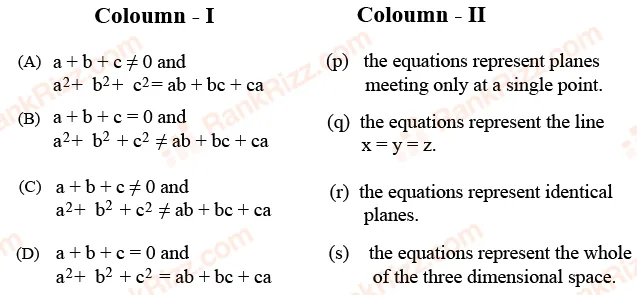
Consider the following linear equations


Match the conditions/expressions in Column I with statements in Column II and indicate your answer by darkening the appropriate bubbles in the matrix given in the ORS.

Q65JEE ADVANCED 2007 · PAPER 1Differentiability at a pointTRANSCRIBED

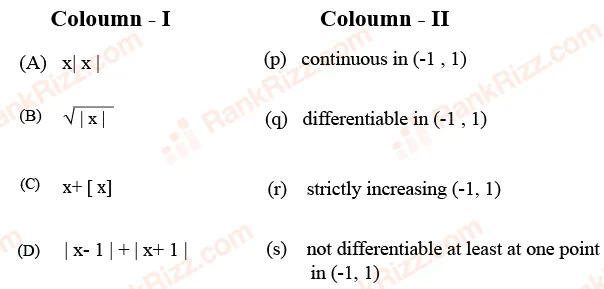
In the following [x] denotes the greatest integer less than or equal to x.
Match the functions in Column I with the properties in Column II and indicate your answer by darkening the appropriate bubbles in the 4 x 4 matrix given in the ORS.

Q66JEE ADVANCED 2007 · PAPER 1Equation of a circle in various formsTRANSCRIBED

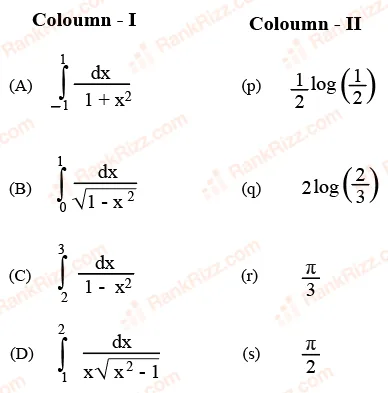
Match the integrals in Column I with the values in Column II and indicate your answer by darkening the appropriate bubbles in the matrix given in the ORS.