RankRizzStart free

Work, Energy & Power — JEE Main Previous Year Questions

Every Work, Energy & Power question JEE Main has set, grouped by the idea it tests rather than the order of the syllabus. 160 questions across 5 distinct ideas. Free to read, answer key on every one.

Questions

160

Distinct ideas

5

Share of marks

2.6%

Difficulty

MEDIUM

The ideas inside Work, Energy & Power

A chapter is not one subject — it is a handful of procedures the examiner reuses. These are the ones Work, Energy & Power questions actually test.

01Work done by constant and variable forcesset 40×
02Kinetic energy and the work-energy theoremset 25×
03Potential energy, conservative forces and energy curvesset 9×
04Conservation of mechanical energyset 60×
05Powerset 26×

Every Work, Energy & Power question

121–140 OF 160 · NEWEST FIRST

JEE MAIN 2018 · 16 APR ONLINEWork done by constant and variable forcesTRANSCRIBED

A body of mass m starts moving from rest along x-axis so that its velocity varies as where a is a constant and s is the distance covered by the body. The total work done by all the forces acting on the body in the first t second after the start of the motion is:

  1. A

  2. B

  3. C

  4. D

JEE MAIN 2018 · 08 APR OFFLINEPotential energy, conservative forces and energy curvesTRANSCRIBED

A particle is moving in a circular path of radius a under the action of an attractive potential . Its total energy is:

  1. A

  2. B

  3. C

  4. D

    Zero

JEE MAIN 2018 · 16 APR ONLINEPotential energy, conservative forces and energy curvesTRANSCRIBED

Two particles of the same mass m are moving in circular orbits because of force, given by . The first particle is at a distance r = 1, and the second, at r = 4. The best estimate for the ratio of kinetic energies of the first and the second particle is closest to:

  1. A

  2. B

  3. C

  4. D

JEE MAIN 2018 · 08 APR OFFLINEPotential energy, conservative forces and energy curvesTRANSCRIBED

In a collinear collision, a particle with an initial speed strikes a stationary particle of the same mass. If the final total kinetic energy is 50% greater than the original kinetic energy, the magnitude of the relative velocity between the two particles, after the collision, is:

  1. A

  2. B

  3. C

  4. D

JEE MAIN 2017 · 02 APR OFFLINEConservation of mechanical energyTRANSCRIBED

A time dependent force acts on a particle of mass 1 kg. If the particle starts from the rest, the work done by the force during the first 1 sec will be:

  1. A

    18 J

  2. B

    4.5 J

  3. C

    22 J

  4. D

    9 J

JEE MAIN 2017 · 08 APR ONLINEConservation of mechanical energyTRANSCRIBED

An object is dropped from a height from the ground. Every time it hits the ground it loses 50% of its kinetic energy. The total distance covered as is:

  1. A

  2. B

  3. C

  4. D

JEE MAIN 2016 · 03 APR OFFLINEConservation of mechanical energyTRANSCRIBED

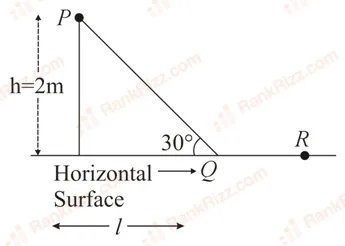
A point particle of mass m, moves along the uniformly rough track PQR as shown in the figure. The coefficient of friction, between the particle and the rough track equals . The particle is released, from rest, from the point P and it comes to rest at a point R. The energies, lost by the ball, over the parts, PQ and QR, of the track, are equal to each other, and no energy is lost when particle changes direction from PQ to QR. The values of the coefficient of friction and the distance x = (QR), are respectively close to:

  1. A

    0.29 and 3.5 m

  2. B

    0.29 and 6.5 m

  3. C

    0.2 and 6.5 m

  4. D

    0.2 and 3.5 m

JEE MAIN 2016 · 03 APR OFFLINEConservation of mechanical energyTRANSCRIBED

A person trying to lose weight by burning fat lifts a mass of 10 kg upto a height of 1 m 1000 times. Assume that the potential energy lost each time he lowers the mass is dissipated. How much fat will he use up considering the work done only when the weight is lifted up? Fat supplies J of energy per kg which is converted to mechanical energy with a 20% efficiency rate. Take ms:

  1. A

    kg

  2. B

    kg

  3. C

    kg

  4. D

    kg

JEE MAIN 2016 · 09 APR ONLINEPowerTRANSCRIBED

A car of weight W is on an inclined road that rises by 100 m over a distance of 1 km and applies a constant frictional force on the car. While moving uphill on the road at a speed of 10 ms, the car needs power P. If it needs power while moving downhill at speed v then the value of v is:

  1. A

    20 ms

  2. B

    5 ms

  3. C

    15 ms

  4. D

    10 ms

JEE MAIN 2016 · 10 APR ONLINEConservation of mechanical energyTRANSCRIBED

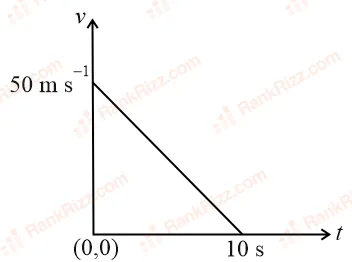
The velocity-time graph of a particle of mass 10 kg is shown in the figure. The net work done on the particle in the first two seconds of the motion is

  1. A

    J

  2. B

    12000 J

  3. C

    J

  4. D

    J

JEE MAIN 2016 · 10 APR ONLINEPowerTRANSCRIBED

A particle of mass M is moving in a circle of fixed radius R in such a way that its centripetal acceleration at time t is given by , where is a constant. The power delivered to the particle by the force acting on it, is:

  1. A

  2. B

  3. C

  4. D

JEE MAIN 2015 · 10 APR ONLINEConservation of mechanical energyTRANSCRIBED

A block of mass kg is connected to a spring of unknown spring constant k. It is compressed to a distance from its equilibrium position and released from rest. After approaching half the distance from the equilibrium position, it hits another block and comes to rest momentarily, while the other block moves with velocity 3 m s. The total initial energy of the spring is:

  1. A

    0.6 J

  2. B

    0.8 J

  3. C

    1.5 J

  4. D

    0.3 J

JEE MAIN 2015 · 11 APR ONLINEPotential energy, conservative forces and energy curvesTRANSCRIBED

A particle is moving in a circle of radius under the action of a force which is directed towards centre of the circle. Total mechanical energy (kinetic energy + potential energy) of the particle is (take potential energy = 0 for ):

  1. A

  2. B

  3. C

  4. D

JEE MAIN 2014 · 19 APR ONLINEKinetic energy and the work-energy theoremTRANSCRIBED

A bullet loses of its velocity passing through one plank. Considering uniform retardation, the number of such planks that are required to stop the bullet can be:

  1. A

    Infinite

  2. B

  3. C

  4. D

JEE MAIN 2014 · 06 APR OFFLINEWork done by constant and variable forcesTRANSCRIBED

When a rubber-band is stretched by a distance x, it exerts a restoring force of magnitude where a and b are constants. The work done in stretching the unstretched rubber-band by L is:

  1. A

  2. B

  3. C

  4. D

JEE MAIN 2014 · 11 APR ONLINEKinetic energy and the work-energy theoremTRANSCRIBED

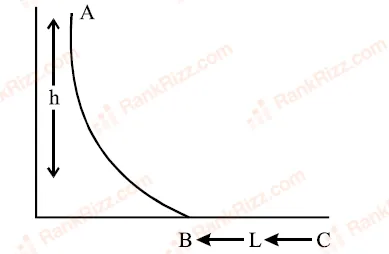
A small ball of mass m starts at a point A with speed and moves along a frictionless track AB as shown. The track BC has coefficient of friction . The ball comes to stop at C after travelling a distance L which is:

  1. A

  2. B

  3. C

  4. D

JEE MAIN 2014 · 12 APR ONLINEKinetic energy and the work-energy theoremTRANSCRIBED

A spring of unstretched length l has a mass m with one end fixed to a rigid support. Assuming spring to be made of a uniform wire, the kinetic energy possessed by it if its free end is pulled with uniform velocity v is:

  1. A

  2. B

  3. C

  4. D

JEE MAIN 2014 · 11 APR ONLINEKinetic energy and the work-energy theoremTRANSCRIBED

The average mass of rain drops is kg and their average terminal velocity is 9 m/s. Calculate the energy transferred by rain to each square metre of the surface at a place which receives 100 cm of rain in a year.

  1. A

    J

  2. B

    J

  3. C

    J

  4. D

    J

JEE MAIN 2013 · 09 APR ONLINEPotential energy, conservative forces and energy curvesTRANSCRIBED

Two springs of force constants 300 N/m (Spring A) and 400 N/m (Spring B) are joined together in series. The combination is compressed by 8.75 cm. The ratio of energy stored in A and B is . Then is equal to:

  1. A

  2. B

  3. C

  4. D

JEE MAIN 2013 · 23 APR ONLINEPowerTRANSCRIBED

A 70 kg man leaps vertically into the air from a crouching position. To take the leap the man pushes the ground with a constant force F to raise himself. The center of gravity rises by 0.5 m before he leaps. After the leap the c.g. rises by another 1 m. The maximum power delivered by the muscles is : (Take g = 10 ms)

  1. A

    Watts at the start

  2. B

    Watts at take off

  3. C

    Watts at the start

  4. D

    Watts at take off