JEE Main 2016 Physics question — Conservation of mechanical energy
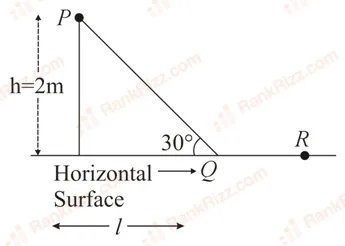
A point particle of mass m, moves along the uniformly rough track PQR as shown in the figure. The coefficient of friction, between the particle and the rough track equals . The particle is released, from rest, from the point P and it comes to rest at a point R. The energies, lost by the ball, over the parts, PQ and QR, of the track, are equal to each other, and no energy is lost when particle changes direction from PQ to QR. The values of the coefficient of friction and the distance x = (QR), are respectively close to:
SOLUTION
On the inclined track , the distance is . The normal force acting on the particle is . The energy lost () is:
On the horizontal track of length , the normal force is simply . The energy lost is .
The energy lost over is equal to the energy lost over ():
This is approximately .
By conservation of energy, the total initial potential energy () equals the total energy dissipated by friction:
Since ,
This value is approximately .
Tagged Conservation of mechanical energy. Machine-assigned, so read it as a strong shortlist rather than a verdict.