JEE Main 2026 Physics question — Dimensional analysis: deriving and checking relations
Match the List-I with List II
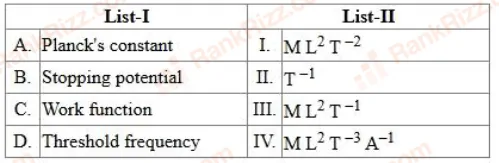
Choose the correct answer from the options given below:
SOLUTION
We recall the basic facts of photo-electric effect:
• , where is Planck’s constant.
• Einstein’s equation , where
= work function (minimum energy required to eject an electron),
= stopping potential, and
= magnitude of electronic charge.
• Threshold frequency satisfies .
Let us evaluate the dimensions of each physical quantity.
Planck’s constant
From we have .
Energy has dimensions and frequency has .
Therefore
, which is set (III).
Stopping potential
Potential (voltage) is work per unit charge: .
Work/energy has and charge has (since current has and ).
Hence
, which is set (IV).
Work function
It is an energy, so
, which is set (I).
Threshold frequency
Frequency is reciprocal of time, so
, which is set (II).
Collecting the matches:
A) Planck’s constant (III)
B) Stopping potential (IV)
C) Work function (I)
D) Threshold frequency (II)
This corresponds to Option A: A-III, B-IV, C-I, D-II.
Tagged Dimensional analysis: deriving and checking relations. Machine-assigned, so read it as a strong shortlist rather than a verdict.