JEE Main 2025 Physics question — Dimensional formulae of physical quantities
Match List-I with List-II.
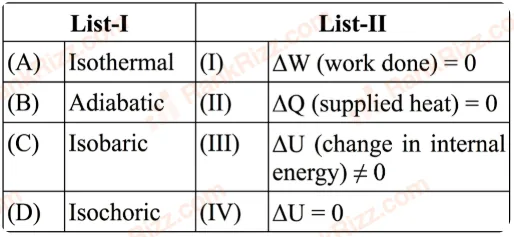
Choose the correct answer from the options given below :
SOLUTION
The first law of thermodynamics gives the relation where:
• is the heat supplied to the system,
• is the change in internal energy,
• is the work done by the system.
For each thermodynamic process we check which of these three quantities is zero or non-zero.
Case A: Isothermal process
Definition: Temperature remains constant.
For an ideal gas, internal energy depends only on temperature, so when temperature is constant .
Heat supplied equals work done, but both are generally non-zero.
Hence the correct description is , i.e. List-II item (IV).
Case B: Adiabatic process
Definition: No heat is exchanged with the surroundings.
Therefore .
Neither nor is automatically zero; they are related by .
Thus the matching statement is , i.e. List-II item (II).
Case C: Isobaric process
Definition: Pressure remains constant.
At constant pressure, the gas expands or compresses, so work is done: .
Temperature usually changes, so internal energy changes: .
Only is listed among the four given statements, therefore we match with List-II item (III).
Case D: Isochoric process
Definition: Volume remains constant.
Work done for a volume change is . With we get .
Heat added goes entirely into changing internal energy: , so neither of them is necessarily zero.
Thus the matching statement is , i.e. List-II item (I).
Collecting the matches:
(A) Isothermal (IV)
(B) Adiabatic (II)
(C) Isobaric (III)
(D) Isochoric (I)
This corresponds to Option C.
Final Answer: Option C [ (A)-(IV), (B)-(II), (C)-(III), (D)-(I) ]
Tagged Dimensional formulae of physical quantities. Machine-assigned, so read it as a strong shortlist rather than a verdict.