JEE Main 2025 Physics question — Dimensional formulae of physical quantities
Match the LIST-I with LIST-II.
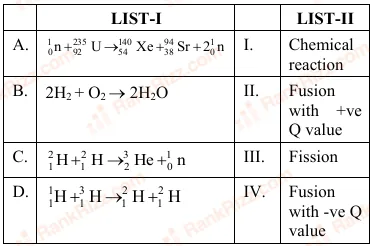
Choose the correct answer from the options given below :
SOLUTION
First recognise the four classes given in LIST-II.
I Chemical reaction - involves only electrons, no change in nucleus, energy of the order of .
II Fusion with ve Q value - two light nuclei combine, total mass decreases, energy is released ().
III Fission - a heavy nucleus splits into two medium-mass nuclei and a few neutrons, energy is released ().
IV Fusion with ve Q value - two nuclei combine but the product mass is larger, energy is absorbed ().
Case A:
A single heavy nucleus breaks into two medium nuclei plus neutrons. According to the definition, this is nuclear fission. Hence A III.
Case B:
Only the electronic configuration of atoms changes; nuclei remain unchanged. This is an ordinary chemical reaction. Hence B I.
Case C:
Two deuterons fuse to form a helium-3 nucleus and a neutron.
Mass of reactants: .
Mass of products: .
, so .
Energy is released; it is a fusion reaction with positive Q value. Hence C II.
Case D:
Mass of reactants: .
Mass of products: .
, so .
Energy is absorbed; it is a fusion reaction with negative Q value. Hence D IV.
Thus the correct matching is
A - III, B - I, C - II, D - IV.
The option representing this pattern is Option B.
Final Answer: Option B
Tagged Dimensional formulae of physical quantities. Machine-assigned, so read it as a strong shortlist rather than a verdict.