JEE Main 2025 Physics question — Dimensional analysis: deriving and checking relations
Match List-I with List-II.
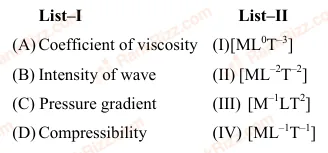
Choose the correct answer from the options below:
SOLUTION
We first write one standard defining relation for each physical quantity and then deduce its dimensional formula.
Case A: Coefficient of viscosity ()
Shear stress
• Dimension of shear stress is the same as pressure: .
• Velocity gradient has dimension .
Therefore,
.
Hence corresponds to List-II (IV).
Case B: Intensity of wave ()
Intensity
• Power .
Energy has dimension , so
.
• Area has dimension .
Therefore,
.
Hence corresponds to List-II (I).
Case C: Pressure gradient ()
Pressure gradient means pressure per unit length:
• Pressure has dimension .
• Length has dimension .
Therefore,
.
Hence corresponds to List-II (II).
Case D: Compressibility ()
Compressibility is the reciprocal of bulk modulus (pressure):
Since the dimension of pressure is , we get
.
Hence corresponds to List-II (III).
Final matching
(A) (IV) [MLT]
(B) (I) [MLT]
(C) (II) [MLT]
(D) (III) [MLT]
Thus the correct set is: (A)-(IV), (B)-(I), (C)-(II), (D)-(III), which is given in Option B.
Answer : Option B
Tagged Dimensional analysis: deriving and checking relations. Machine-assigned, so read it as a strong shortlist rather than a verdict.