We have to find the fractional (relative) error in Young’s modulus, whose working formula for the experiment is Y=4bd3δMgl3.
In error analysis, when a quantity is a product or quotient of measured quantities raised to powers, the fractional error in the result equals the algebraic sum of the absolute values of the fractional errors of each factor, each multiplied by its power. Stated formally, if Q=ApBqCr…, then QΔQ=∣p∣AΔA+∣q∣BΔB+∣r∣CΔC+….
Comparing with Y=4bd3δMgl3, we notice that g and the numerical constant 4 are exact, so they contribute no error. The powers of the remaining variables are:
M+1,l+3,b−1,d−3,δ−1.$
Therefore,
YΔY=MΔM+3lΔl+bΔb+3dΔd+δΔδ.
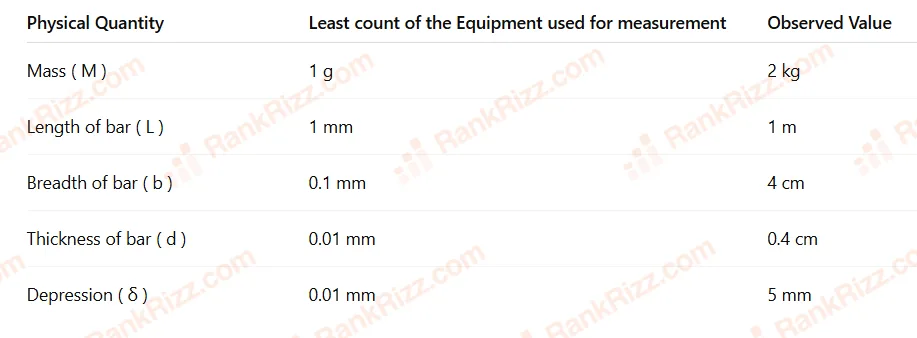
The absolute error in each measurement is taken as its least count. We now convert every quantity and its least count to the same unit (SI) and evaluate each fractional error.
Mass: observed M=2 kg,least count=1 g=0.001 kg.$
MΔM=20.001=0.0005.
Length of bar: observed l=1 m,least count=1 mm=0.001 m.$
lΔl=10.001=0.001.
Breadth: observed b=4 cm=0.04 m,least count=0.1 mm=0.0001 m.$
bΔb=0.040.0001=0.0025.
Thickness: observed d=0.4 cm=0.004 m,least count=0.01 mm=0.00001 m.$
dΔd=0.0040.00001=0.0025.
Depression: observed δ=5 mm=0.005 m,least count=0.01 mm=0.00001 m.$
δΔδ=0.0050.00001=0.002.
Substituting all these fractional errors into the earlier relation, we get
YΔY=0.0005+3(0.001)+0.0025+3(0.0025)+0.002=0.0005+0.003+0.0025+0.0075+0.002=0.0155.$
Thus the fractional error in the measurement of Y is 0.0155.
Hence, the correct answer is Option D.