RankRizz
JEE MAIN 2016 · 03 APR OFFLINE+4 / −1MEDIUMTRANSCRIBED

JEE Main 2016 Physics question — Work done in thermodynamic processes and P-V diagrams

nn moles of an ideal gas undergoes a process A→BA \to B as shown in the figure. The maximum temperature of the gas during the process will be:
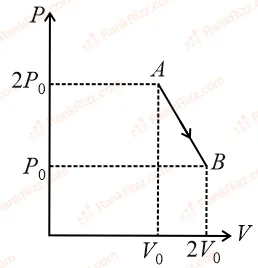
Figure for JEE Main 2016 Physics question on Work done in thermodynamic processes and P-V diagrams
SOLUTION

The coordinates of the two marked points on the P−VP-V diagram can be read directly from the figure.

At point AA, the pressure is twice the reference value while the volume equals the reference value, so PA=2P0,VA=V0.P_A = 2P_0 ,\qquad V_A = V_0.

At point BB, the pressure is the reference value while the volume is twice the reference value, so PB=P0,VB=2V0.P_B = P_0 ,\qquad V_B = 2V_0.

During the process A→BA \rightarrow B the line joining the two points is a straight line on the P−VP-V plane. Hence the relation between pressure and volume is linear and can be written in the form P=mV+c,P = mV + c, where mm is the slope and cc is the intercept.

We first evaluate the slope. Using the two end-points,

m=PB−PAVB−VA</p><p>=P0−2P0 2V0−V0 </p><p>=−P0V0.m = \frac{P_B - P_A}{V_B - V_A}</p> <p> = \frac{P_0 - 2P_0}{\,2V_0 - V_0\,}</p> <p> = \frac{-P_0}{V_0}.

Next we find the intercept by substituting the co-ordinates of point AA: PA=mVA+c  ⟹  2P0=(−P0V0)V0+c  ⟹  c=3P0.P_A = mV_A + c \;\Longrightarrow\; 2P_0 = \left(-\frac{P_0}{V_0}\right)V_0 + c \;\Longrightarrow\; c = 3P_0.

So the complete equation of the path is P=−P0V0 V+3P0.P = -\frac{P_0}{V_0}\,V + 3P_0.

For an ideal gas, the temperature at any stage is given by the ideal-gas law T=PVnR.T = \frac{PV}{nR}.

Substituting the expression for PP obtained above, the temperature as a function of volume becomes

T(V)=(−P0V0V+3P0)VnR</p><p>=P0nR(−V2V0+3V).T(V) = \frac{\left(-\dfrac{P_0}{V_0}V + 3P_0\right)V}{nR}</p> <p> = \frac{P_0}{nR}\left(-\frac{V^2}{V_0} + 3V\right).

To locate the maximum temperature, we differentiate this expression with respect to volume and set the derivative to zero:

dTdV=P0nR(−2VV0+3).\frac{dT}{dV} = \frac{P_0}{nR}\left(-\frac{2V}{V_0} + 3\right).

At the extremum, dTdV=0,\dfrac{dT}{dV}=0, so

−2VV0+3=0</p><p>  ⟹  2VV0=3</p><p>  ⟹  V=32V0.-\frac{2V}{V_0} + 3 = 0 </p> <p> \;\Longrightarrow\; \frac{2V}{V_0} = 3</p> <p> \;\Longrightarrow\; V = \frac{3}{2}V_0.

This intermediate volume is indeed between V0V_0 and 2V0,2V_0, confirming that we have an internal maximum.

We now calculate the corresponding pressure. Substituting V=32V0V = \dfrac{3}{2}V_0 into the line equation,

P=−P0V0(32V0)+3P0</p><p>=−32P0+3P0</p><p>=32P0.P = -\frac{P_0}{V_0}\left(\frac{3}{2}V_0\right) + 3P_0</p> <p> = -\frac{3}{2}P_0 + 3P_0</p> <p> = \frac{3}{2}P_0.

Finally, substituting these PP and VV values back into the ideal-gas relation gives the maximum temperature:

Tmax</p><p>=PVnR</p><p>=(32P0)(32V0)nR</p><p>=9P0V04nR.T_{\text{max}}</p> <p> = \frac{PV}{nR}</p> <p> = \frac{\left(\dfrac{3}{2}P_0\right)\left(\dfrac{3}{2}V_0\right)}{nR}</p> <p> = \frac{9P_0V_0}{4nR}.

Hence, the correct answer is Option C.

Tagged Work done in thermodynamic processes and P-V diagrams. Machine-assigned, so read it as a strong shortlist rather than a verdict.

SubjectPhysics
TopicWork done in thermodynamic processes and P-V diagrams
TypeMultiple choice