JEE Main 2019 Physics question — Heat conduction and thermal resistance
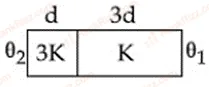
Two materials having coefficients of thermal conductivity 3K and K and thickness d and 3d respectively, are joined to form a slab as shown in the figure. The temperatures of the outer surfaces are and respectively, . The temperature at the interface is:
SOLUTION
Step-by-Step Solution
1. Principle of Heat Conduction in Series
When two conducting layers are joined in series to form a composite slab under steady-state conditions, the rate of heat flow () through both materials must be identical.
The rate of heat conduction is governed by Fourier's Law:
Where:
- = Coefficient of thermal conductivity
- = Cross-sectional area
- = Temperature difference across the layer
- = Thickness of the layer
- For Slab 1: Thermal conductivity is , thickness is , and the temperature difference is .
- For Slab 2: Thermal conductivity is , thickness is , and the temperature difference is .
2. Set Up the Heat Flow Balance Equation
Let the unknown interface temperature be .
Equating the two heat flow rates:
3. Simplify and Solve for
Cancel out the common parameters ( and ) from both sides:
Multiply the entire equation by to eliminate the fraction:
Expand the left side:
Group the terms containing onto one side:
Separating the terms yields:
Final Answer
The temperature at the interface is (or ).
Tagged Heat conduction and thermal resistance. Machine-assigned, so read it as a strong shortlist rather than a verdict.