JEE Main 2020 Physics question — Heat conduction and thermal resistance
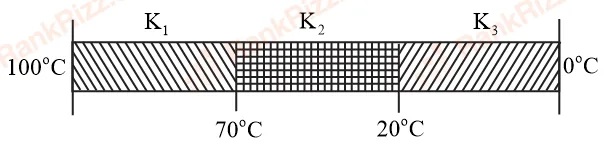
Three rods of identical cross-section and length are made of three different materials of thermal conductivity , and , respectively. They are joined together at their ends to make a long rod (see figure). One end of the long rod is maintained at and the other at (see figure). If the joints of the rod are at and in steady state and there is no loss of energy from the surface of the rod, the correct relationship between , and is:
SOLUTION
We have three rods, each of identical length and identical cross-sectional area . Their thermal conductivities are and , respectively. They are joined end to end. The left-most end is kept at , the right-most end is kept at . In steady state the temperatures at the two junctions are given to be and , as shown below:
Because no heat is lost through the lateral surfaces, the same heat current flows through every section of the composite rod in steady state.
Fourier’s law of heat conduction states first:
where is the thermal conductivity of that section, is the cross-sectional area, is the temperature difference across the length of that section.
Applying this formula to each rod separately and remembering that and are the same for all rods, we write the heat current for every rod explicitly.
For Rod 1 (from to ):
For Rod 2 (from to ):
For Rod 3 (from to ):
Because the heat current is the same everywhere, we equate these three expressions:
The common factors and cancel from all three terms, giving the simpler equality
We now obtain the required ratios by pairwise comparison. First, comparing the first two terms:
Dividing both sides by :
Next, comparing the second and third terms:
Dividing both sides by :
From the above two ratios, we can also find logically. We already have
Therefore, writing all the ratios in the simplest integer form:
These two relations match exactly with Option A of the given choices. No other option is consistent with both ratios simultaneously.
Hence, the correct answer is Option A.
Tagged Heat conduction and thermal resistance. Machine-assigned, so read it as a strong shortlist rather than a verdict.