JEE Main 2019 Physics question — Transistors (older syllabus)
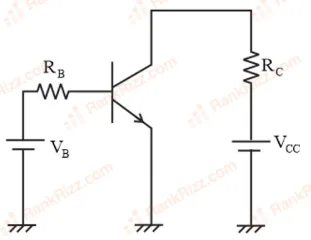
A common emitter amplifier circuit, built using an NPN transistor, is shown in the figure. Its dc current gain is 250, k and V. The minimum base current for to reach saturation is:
SOLUTION
In a common emitter amplifier using an NPN transistor, the saturation state and base current are calculated as follows:
At the saturation state, the collector-emitter voltage reaches its minimum value (approximately zero).
The collector current is determined by:
Substituting the given values ( and ):
The relationship between collector current and base current is defined by the DC current gain ():
Rearranging to solve for the minimum base current :
Substituting I_C = 10\text{ mA}$ and $\beta = 250:
Converting to microamperes:
Tagged Transistors (older syllabus). Machine-assigned, so read it as a strong shortlist rather than a verdict.