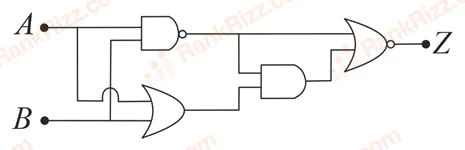
In the following digital circuit, what will be the output 'Z', when the input (A, B) are (1, 0), (0, 0), (1, 1), (0, 1):
0, 0, 1, 0
1, 0, 1, 1
1, 1, 0, 1
0, 1, 0, 0
NAND gate output: Y1=A⋅B‾\text{NAND gate output: } Y_1 = \overline{A \cdot B}NAND gate output: Y1=A⋅B
OR gate output: Y2=A+B\text{OR gate output: } Y_2 = A + BOR gate output: Y2=A+B
AND gate output: Y3=Y1⋅Y2=(A⋅B‾)⋅(A+B)\text{AND gate output: } Y_3 = Y_1 \cdot Y_2 = (\overline{A \cdot B}) \cdot (A + B)AND gate output: Y3=Y1⋅Y2=(A⋅B)⋅(A+B)
Final NOR gate output: Z=Y1+Y3‾\text{Final NOR gate output: } Z = \overline{Y_1 + Y_3}Final NOR gate output: Z=Y1+Y3
Z=A⋅B‾+(A⋅B‾)⋅(A+B)‾=A⋅B‾‾=A⋅BZ = \overline{\overline{A \cdot B} + (\overline{A \cdot B}) \cdot (A + B)} = \overline{\overline{A \cdot B}} = A \cdot BZ=A⋅B+(A⋅B)⋅(A+B)=A⋅B=A⋅B
For (A,B)=(1,0) ⟹ Z=1⋅0=0\text{For } (A, B) = (1, 0) \implies Z = 1 \cdot 0 = 0For (A,B)=(1,0)⟹Z=1⋅0=0
For (A,B)=(0,0) ⟹ Z=0⋅0=0\text{For } (A, B) = (0, 0) \implies Z = 0 \cdot 0 = 0For (A,B)=(0,0)⟹Z=0⋅0=0
For (A,B)=(1,1) ⟹ Z=1⋅1=1\text{For } (A, B) = (1, 1) \implies Z = 1 \cdot 1 = 1For (A,B)=(1,1)⟹Z=1⋅1=1
For (A,B)=(0,1) ⟹ Z=0⋅1=0\text{For } (A, B) = (0, 1) \implies Z = 0 \cdot 1 = 0For (A,B)=(0,1)⟹Z=0⋅1=0
Tagged Logic gates and digital circuits. Machine-assigned, so read it as a strong shortlist rather than a verdict.