RankRizz
JEE MAIN 2019 · 12 JAN S2+4 / −1MEDIUMTRANSCRIBED

JEE Main 2019 Physics question — Transistors (older syllabus)

In the figure, given that VBBV_{BB} supply can vary from 0 to 5.0 V, VCC=5V_{CC} = 5 V, βdc=200\beta_{dc} = 200, RB=100R_B = 100 kΩ\Omega, RC=1R_C = 1 kΩ\Omega and VBE=1.0V_{BE} = 1.0 V. The minimum base current and the input voltage at which the transistor will go to saturation, will be, respectively:
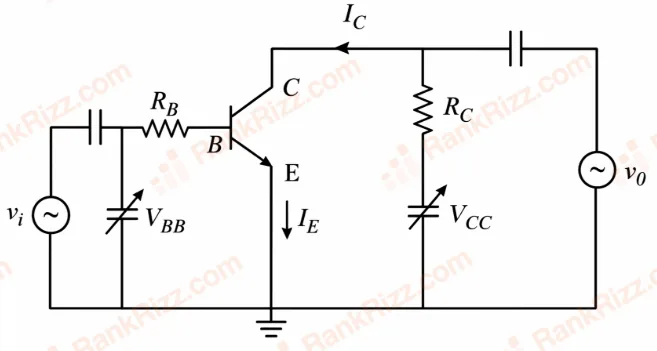
Figure for JEE Main 2019 Physics question on Transistors (older syllabus)
SOLUTION

We first recall that a transistor enters saturation when the collector current reaches the value

IC(sat)=VCC−VCE(sat)RC.I_{C(sat)}=\dfrac{V_{CC}-V_{CE(sat)}}{R_C}.

For a silicon BJT the saturated collector-emitter voltage is generally taken as

VCE(sat)≈0.2  V.V_{CE(sat)}\approx0.2\;{\rm V}.

Substituting the given numbers,

IC(sat)=5.0  V−0.2  V1  kΩ=4.8  V1000  Ω=4.8×10⁻³  A=4.8  mA.I_{C(sat)}=\dfrac{5.0\;{\rm V}-0.2\;{\rm V}}{1\;{\rm k}\Omega} =\dfrac{4.8\;{\rm V}}{1000\;\Omega}=4.8\times10^{-3}\;{\rm A}=4.8\;{\rm mA}.

The minimum base current capable of driving this collector current is obtained from the definition of the dc current gain

βdc=ICIB  ⟹  IB(min)=IC(sat)βdc.\beta_{dc}=\dfrac{I_C}{I_B}\;\Longrightarrow\; I_{B(min)}=\dfrac{I_{C(sat)}}{\beta_{dc}}.

Using βdc=200\beta_{dc}=200, we have

IB(min)=4.8  mA200=24×10−6  A=24  μA.I_{B(min)}=\dfrac{4.8\;{\rm mA}}{200}=24\times10^{-6}\;{\rm A}=24\;\mu{\rm A}.

Because the data provided are rounded, we recognise that this is effectively

IB(min)≈25  μA.I_{B(min)}\approx25\;\mu{\rm A}.

Next, the input supply VBBV_{BB} is related to the base current by the simple bias relation

IB=VBB−VBERB,I_B=\dfrac{V_{BB}-V_{BE}}{R_B},

where VBE=1.0  VV_{BE}=1.0\;{\rm V} and RB=100  kΩ.R_B=100\;{\rm k}\Omega.

Re-arranging gives

VBB=IB RB+VBE.V_{BB}=I_B\,R_B+V_{BE}.

Substituting IB=25  μA=25×10−6  AI_B=25\;\mu{\rm A}=25\times10^{-6}\;{\rm A}, we obtain

VBB=25×10−6  A×100×103  Ω+1.0  V=2.5  V+1.0  V=3.5  V.V_{BB}=25\times10^{-6}\;{\rm A}\times100\times10^{3}\;\Omega+1.0\;{\rm V} =2.5\;{\rm V}+1.0\;{\rm V}=3.5\;{\rm V}.

Thus the transistor just enters saturation when the base current is about 25  μA25\;\mu{\rm A} and the corresponding input voltage is 3.5  V3.5\;{\rm V}.

Hence, the correct answer is Option C.

Tagged Transistors (older syllabus). Machine-assigned, so read it as a strong shortlist rather than a verdict.

SubjectPhysics
TopicTransistors (older syllabus)
TypeMultiple choice