RankRizz
JEE MAIN 2019 · 12 APR S1+4 / −1MEDIUMTRANSCRIBED

JEE Main 2019 Physics question — Transistors (older syllabus)

The transfer characteristic curve of a transistor, having input and output resistance 100 Ω and 100 kΩ respectively, is shown in the figure. The voltage and power gain, are respectively:
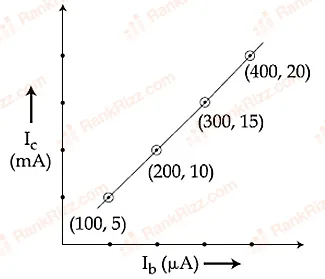
Figure for JEE Main 2019 Physics question on Transistors (older syllabus)
SOLUTION

The graph supplied in the question is the transfer (current-current) characteristic of the transistor, that is, it plots the small-signal output current ΔIout\Delta I_{out} (collector current) against the corresponding small-signal input current ΔIin\Delta I_{in} (base current). The slope of this straight-line graph is therefore

β  =  ΔIoutΔIin,\beta \;=\; \frac{\Delta I_{out}}{\Delta I_{in}},

which is the small-signal current gain AiA_i of the transistor. From the figure we read that for every 1 mA1\text{ mA} change in input current the output current changes by 50 mA50\text{ mA}, so

Ai  =  β  =  50.A_i \;=\; \beta \;=\; 50.

We are asked next for the voltage gain. First we recall the general relationship connecting voltage gain, current gain and the resistances of the input and output circuits. For small signals,

Av  =  ΔVoutΔVin.A_v \;=\; \frac{\Delta V_{out}}{\Delta V_{in}}.

Now ΔVout=ΔIout Rout\Delta V_{out} = \Delta I_{out}\,R_{out} and ΔVin=ΔIin Rin\Delta V_{in} = \Delta I_{in}\,R_{in}, so substituting these into the above definition gives

Av  =  ΔIout RoutΔIin Rin  =  (ΔIoutΔIin) ⁣(RoutRin).A_v \;=\; \frac{\Delta I_{out}\,R_{out}}{\Delta I_{in}\,R_{in}} \;=\; \left(\frac{\Delta I_{out}}{\Delta I_{in}}\right)\! \left(\frac{R_{out}}{R_{in}}\right).

We already have ΔIoutΔIin=50\dfrac{\Delta I_{out}}{\Delta I_{in}} = 50, and the data in the statement give the resistances

Rin=100 Ω,Rout=100 kΩ=1.0×10⁵ Ω.R_{in} = 100\ \Omega , \qquad R_{out} = 100\ \text{k}\Omega = 1.0\times10^{5}\ \Omega.

Hence

Av  =  50×1.0×105100  =  50×1000  =  5.0×104.A_v \;=\; 50 \times \frac{1.0\times10^{5}}{100} \;=\; 50 \times 1000 \;=\; 5.0 \times 10^{4}.

Finally, the power gain is required. The small-signal power gain is defined as

Ap  =  output powerinput power  =  ΔVout ΔIoutΔVin ΔIin  =  Av×Ai.A_p \;=\; \frac{\text{output power}}{\text{input power}} \;=\; \frac{\Delta V_{out}\,\Delta I_{out}} {\Delta V_{in}\,\Delta I_{in}} \;=\; A_v \times A_i.

Substituting the numerical values we have just obtained,

Ap  =  (5.0×10⁴) ⁣×50  =  2.5×106.A_p \;=\; \left(5.0 \times 10^{4}\right)\!\times 50 \;=\; 2.5 \times 10^{6}.

Thus the voltage gain is 5×1045 \times 10^{4} and the power gain is 2.5×1062.5 \times 10^{6}.

Hence, the correct answer is Option A.

Tagged Transistors (older syllabus). Machine-assigned, so read it as a strong shortlist rather than a verdict.

SubjectPhysics
TopicTransistors (older syllabus)
TypeMultiple choice