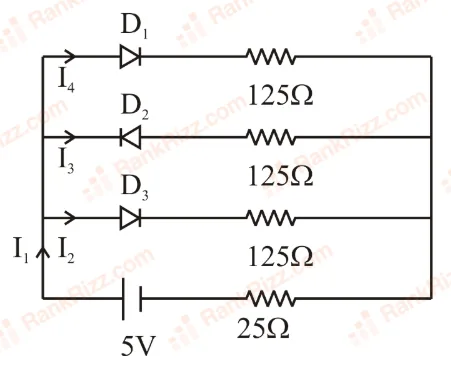
If each diode has a forward bias resistance of 25Ω\OmegaΩ in the below circuit, which of the following options is correct?
I1I2=1\frac{I_1}{I_2} = 1I2I1=1
I2I3=1\frac{I_2}{I_3} = 1I3I2=1
I1I2=2\frac{I_1}{I_2} = 2I2I1=2
I3I4=1\frac{I_3}{I_4} = 1I4I3=1
Based on the 5 V source, D1 and D3 are forward-biased, while D2 is reverse-biased (open circuit)\text{Based on the } 5\text{ V source, } D_1 \text{ and } D_3 \text{ are forward-biased, while } D_2 \text{ is reverse-biased (open circuit)}Based on the 5 V source, D1 and D3 are forward-biased, while D2 is reverse-biased (open circuit)
⟹ I3=0\implies I_3 = 0⟹I3=0
Rbranch1=Rbranch3=25+125=150 Ω ⟹ I4=I2=Vparallel150R_{\text{branch1}} = R_{\text{branch3}} = 25 + 125 = 150\,\Omega \implies I_4 = I_2 = \frac{V_{\text{parallel}}}{150}Rbranch1=Rbranch3=25+125=150Ω⟹I4=I2=150Vparallel
I1=I4+I3+I2=I2+0+I2=2I2 ⟹ I1I2=2I_1 = I_4 + I_3 + I_2 = I_2 + 0 + I_2 = 2I_2 \implies \frac{I_1}{I_2} = 2I1=I4+I3+I2=I2+0+I2=2I2⟹I2I1=2
Tagged p-n junction diode and its characteristics. Machine-assigned, so read it as a strong shortlist rather than a verdict.