JEE Main 2016 Physics question — Torque and the rotational form of Newton's second law
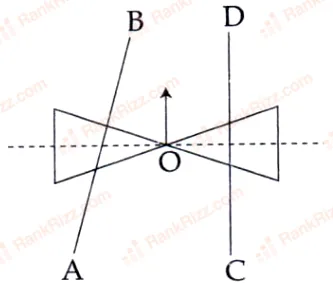
A roller is made by joining together two cones at their vertices O. It is kept on two rails AB and CD which are placed asymmetrically, with its axis perpendicular to CD and its centre O at the centre of line joining AB and CD (see the figure below). It is given a light push so that it starts rolling with its centre O moving parallel to CD in the direction shown. As it moves, the roller will tend to:
SOLUTION
As the roller moves forward, the contact point on the left side moves closer to the vertex . Since the radius of a cone decreases as you move toward the vertex, the radius of the roller at the left contact point () reduces.
Since the radius on the left side () is decreasing while the radius on the right side () remains constant, becomes smaller than ().
Left side velocity:
Right side velocity:
Because , the linear velocity of the left side is lower than that of the right side (). When one side of a rolling object moves slower than the other, the object pivots toward the slower side.
Therefore, as the roller moves forward, it will tend to turn left.
Tagged Torque and the rotational form of Newton's second law. Machine-assigned, so read it as a strong shortlist rather than a verdict.