RankRizz
JEE MAIN 2016 · 03 APR OFFLINE+4 / −1MEDIUMTRANSCRIBED

JEE Main 2016 Physics question — Angular momentum of particles and rigid bodies

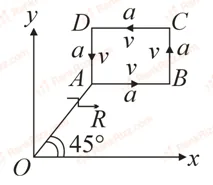
A particle of mass m is moving along the side of a square of side 'a', with a uniform speed v in the x-y plane as shown in the figure:

Figure for JEE Main 2016 Physics question on Angular momentum of particles and rigid bodies


Which of the following statements is false for the angular momentum L⃗\vec{L} about the origin?

SOLUTION

Coordinates of points:

A=(Rcos⁡45∘,Rsin⁡45∘)=(R2,R2)A = \left( R\cos45^\circ, R\sin45^\circ \right) = \left( \frac{R}{\sqrt{2}}, \frac{R}{\sqrt{2}} \right)

B=(R2+a,R2)B = \left( \frac{R}{\sqrt{2}} + a, \frac{R}{\sqrt{2}} \right) (moving distance aa along the x-axis)

C=(R2+a,R2+a)C = \left( \frac{R}{\sqrt{2}} + a, \frac{R}{\sqrt{2}} + a \right) (moving distance aa along the y-axis)

D=(R2,R2+a)D = \left( \frac{R}{\sqrt{2}}, \frac{R}{\sqrt{2}} + a \right) (moving distance aa back along the x-axis)

    The general formula for angular momentum is L⃗=r⃗×p⃗=m(r⃗×v⃗)\vec{L} = \vec{r} \times \vec{p} = m(\vec{r} \times \vec{v}).

    Path A to B (Moving Right)

    Velocity: v⃗=vi^\vec{v} = v\hat{i}

    Constant y-component: y=R2y = \frac{R}{\sqrt{2}}

    L⃗=m(xi^+R2j^)×(vi^)=−mvR2k^\vec{L} = m \left( x\hat{i} + \frac{R}{\sqrt{2}}\hat{j} \right) \times (v\hat{i}) = -mv \frac{R}{\sqrt{2}}\hat{k}

    Statement C is TRUE.

      Path B to C (Moving Up)

      Velocity: v⃗=vj^\vec{v} = v\hat{j}

      Constant x-component: x=R2+ax = \frac{R}{\sqrt{2}} + a

      L⃗=m([R2+a]i^+yj^)×(vj^)=mv(R2+a)k^\vec{L} = m \left( \left[\frac{R}{\sqrt{2}} + a\right]\hat{i} + y\hat{j} \right) \times (v\hat{j}) = mv \left( \frac{R}{\sqrt{2}} + a \right)\hat{k}

      Statement A is TRUE.

        Path C to D (Moving Left)

        Velocity: v⃗=−vi^\vec{v} = -v\hat{i}

        Constant y-component: y=R2+ay = \frac{R}{\sqrt{2}} + a

        L⃗=m(xi^+[R2+a]j^)×(−vi^)=mv(R2+a)k^\vec{L} = m \left( x\hat{i} + \left[\frac{R}{\sqrt{2}} + a\right]\hat{j} \right) \times (-v\hat{i}) = mv \left( \frac{R}{\sqrt{2}} + a \right)\hat{k}

        Statement D is TRUE.

          Path D to A (Moving Down)

          Velocity: v⃗=−vj^\vec{v} = -v\hat{j}

          Constant x-component: x=R2x = \frac{R}{\sqrt{2}}

          L⃗=m(R2i^+yj^)×(−vj^)=−mvR2k^\vec{L} = m \left( \frac{R}{\sqrt{2}}\hat{i} + y\hat{j} \right) \times (-v\hat{j}) = -mv \frac{R}{\sqrt{2}}\hat{k}

           Statement B is FALSE because it incorrectly gives a positive +k^+\hat{k} direction.

            Tagged Angular momentum of particles and rigid bodies. Machine-assigned, so read it as a strong shortlist rather than a verdict.

            SubjectPhysics
            TopicAngular momentum of particles and rigid bodies
            TypeMultiple choice