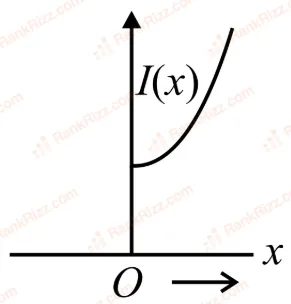
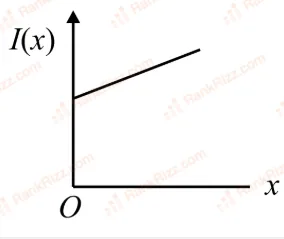
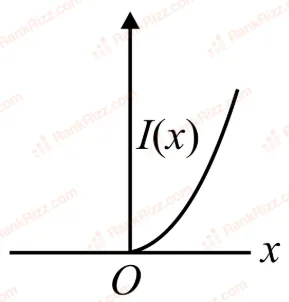
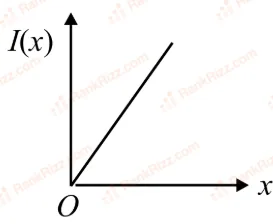
The moment of inertia of a solid sphere, about an axis parallel to its diameter and at a distance of x from it, is . Which one of the graphs represents the variation of with x correctly?
- A
- B
- C
- D
Every Rotational Motion question JEE Main has set, grouped by the idea it tests rather than the order of the syllabus. 276 questions across 10 distinct ideas. Free to read, answer key on every one.
Questions
276
Distinct ideas
10
Share of marks
5.6%
Difficulty
MEDIUM
A chapter is not one subject — it is a handful of procedures the examiner reuses. These are the ones Rotational Motion questions actually test.
221–240 OF 276 · NEWEST FIRST
The moment of inertia of a solid sphere, about an axis parallel to its diameter and at a distance of x from it, is . Which one of the graphs represents the variation of with x correctly?


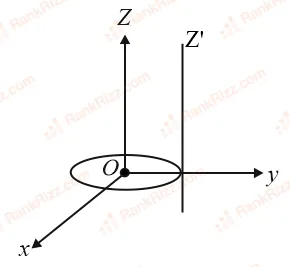
A thin circular disk is in the xy plane as shown in the figure. The ratio of its moment of inertia about z and z' axes will be:

1 : 4
1 : 5
1 : 3
1 : 2
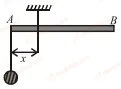
A uniform rod AB is suspended from a point X, at a variable distance x from A, as shown. To make the rod horizontal, a mass m is suspended from its end A. A set of (m, x) values is recorded. The appropriate variable that give a straight line, when plotted, are:

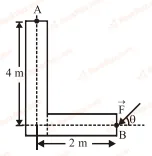
A force of 40 N acts on a point B at the end of an L-shaped object, as shown in the figure. The angle that will produce maximum moment of the force about point A is given by:
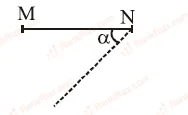
A thin rod MN, free to rotate in the vertical plane about the fixed end N, is held horizontal. When the end M is released, the speed of this end, when the rod makes an angle with the horizontal, will be proportional to: (see figure)

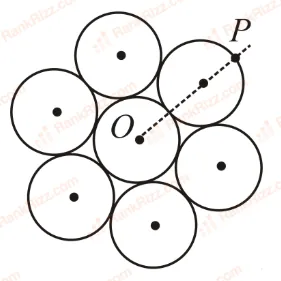
Seven identical circular planar disks, each of mass M and radius R are welded symmetrically as shown. The moment of inertia of the arrangement about the axis normal to the plane and passing through the point P is:

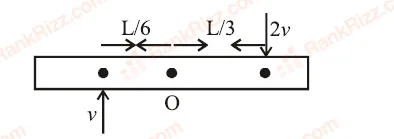
A thin uniform bar of length L and mass 8 m lies on a smooth horizontal table. Two point masses m and 2 m moving in the same horizontal plane from opposite sides of the bar with speeds 2v and v respectively. The masses stick to the bar after collision at a distance and respectively from the centre of the bar. If the bar starts rotating about its center of mass as a result of collision, the angular speed of the bar will be:

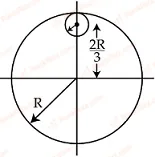
From a uniform circular disc of radius R and mass 9 M, a small disc of radius is removed as shown in the figure. The moment of inertia of the remaining disc about an axis perpendicular to the plane of the disc and passing through centre of disc is:
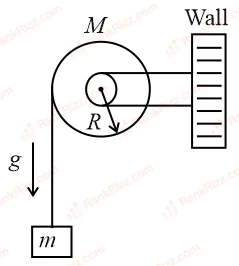
A uniform disc of radius and mass is free to rotate only about its axis. A string is wrapped over its rim and a body of mass is tied to the free end of the string as shown in the figure. The body is released from rest. Then the acceleration of the body is:

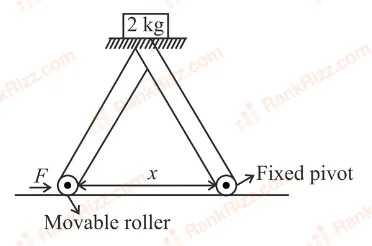
The machine as shown has 2 rods of length 1 m connected by a pivot at the top. The end of one rod is connected to the floor by a stationary pivot and the end of the other rod has a roller that rolls along the floor in a slot. As the roller goes back and forth, a 2 kg weight moves up and down. If the roller is moving towards right at a constant speed, the weight moves up with a:

Speed which is th of that of the roller when the weight is 0.4 m above the ground
Constant speed
Decreasing speed
Increasing speed
The moment of inertia of a uniform cylinder of length and radius about its perpendicular bisector is . What is the ratio such that the moment of inertia is minimum?
1
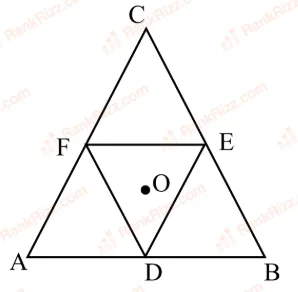
Moment of inertia of an equilateral triangular lamina , about the axis passing through its centre and perpendicular to its plane is as shown in the figure. A cavity is cut out from the lamina, where , , are the mid points of the sides. Moment of inertia of the remaining part of lamina about the same axis is:

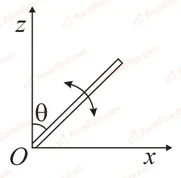
A slender uniform rod of mass and length is pivoted at one end so that it can rotate in a vertical plane (see figure). There is negligible friction at the pivot. The free end is held vertically above the pivot and then released. The angular acceleration of the rod when it makes an angle with the vertical is:

In a physical balance working on the principle of moments, when 5 mg weight is placed on the left pan, the beam becomes horizontal. Both the empty pans of the balance are of equal mass. Which of the following statements is correct?
Every object that is weighed using this balance appears lighter than its actual weight
Left arm is shorter than the right arm
Both the arms are of same length
Left arm is longer than the right arm
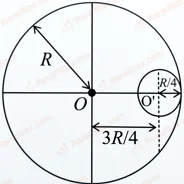
A circular hole of radius is made in a thin uniform disc having mass and radius , as shown in figure. The moment of inertia of the remaining portion of the disc about an axis passing through the point O and perpendicular to the plane of the disc is-

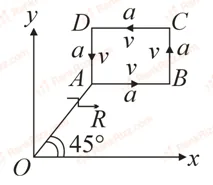
A particle of mass m is moving along the side of a square of side 'a', with a uniform speed v in the x-y plane as shown in the figure:
Which of the following statements is false for the angular momentum about the origin?
when the particle is moving from B to C.
when the particle is moving from D to A.
when the particle is moving from A to B.
when the particle is moving from C to D.
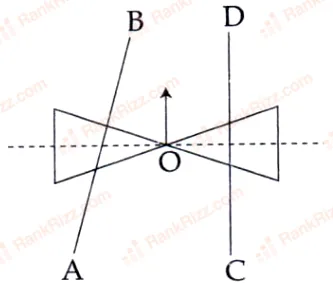
A roller is made by joining together two cones at their vertices O. It is kept on two rails AB and CD which are placed asymmetrically, with its axis perpendicular to CD and its centre O at the centre of line joining AB and CD (see the figure below). It is given a light push so that it starts rolling with its centre O moving parallel to CD in the direction shown. As it moves, the roller will tend to:

go straight.
turn left and right alternately.
turn left.
turn right.
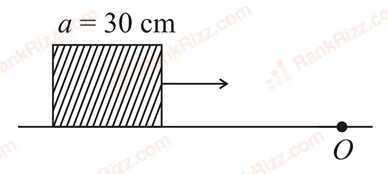
A cubical block of side 30 cm is moving with velocity 2 m s on a smooth horizontal surface. The surface has a bump at a point O as shown in the figure. The angular velocity (in rad/s) of the block immediately after it hits the bump, is:

13.3
5.0
9.4
6.7
Consider a thin uniform square sheet made of a rigid material. If its side is , mass m and moment of inertia about one of its diagonals, then:
\frac{ma^2}{24} < I < \frac{ma^2}{12}
I > \frac{ma^2}{12}
From a solid sphere of mass and radius , a cube of the maximum possible volume is cut. Moment of inertia of cube about an axis passing through its centre and perpendicular to one of its faces is:
OTHER PHYSICS CHAPTERS