The region between and contains a magnetic field . A particle of mass m and charge q enters the region with a velocity . If , the acceleration of the charged particle at the point of its emergence at the other side is:
- A
- B
- C
- D
None of the above
Every Moving Charges & Magnetism question JEE Main has set, grouped by the idea it tests rather than the order of the syllabus. 249 questions across 8 distinct ideas. Free to read, answer key on every one.
Questions
249
Distinct ideas
8
Share of marks
3.8%
Difficulty
MEDIUM
A chapter is not one subject — it is a handful of procedures the examiner reuses. These are the ones Moving Charges & Magnetism questions actually test.
181–200 OF 249 · NEWEST FIRST
The region between and contains a magnetic field . A particle of mass m and charge q enters the region with a velocity . If , the acceleration of the charged particle at the point of its emergence at the other side is:
None of the above
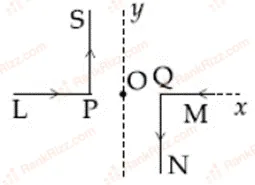
As shown in the figure, two infinitely long, identical wires are bent by 90° and placed in such a way that the segments LP and QM are along the x-axis, while segments PS and QN are parallel to the y-axis. If cm, and the magnitude of the magnetic field at O is T, and the two wires carry equal currents (see figure), the magnitude of the current in each wire and the direction of the magnetic field at O will be :

20 A, perpendicular into the page
20 A, perpendicular out of the page
40 A, perpendicular into the page
40 A, perpendicular out of the page
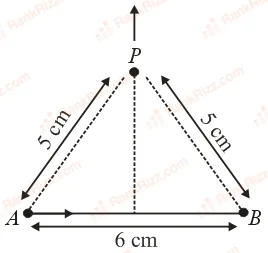
Find the magnetic field at point P due to a straight line segment AB of length 6 cm carrying a current of 5 A. (See figure) ( NA)

T
T
T
T
A particle of mass m and charge q is in an electric and magnetic field given by ; . The charged particle is shifted from the origin to the point P along a straight path. The magnitude of the total work done is:
(0.35)q
5q
(2.5) q
(0.15)q
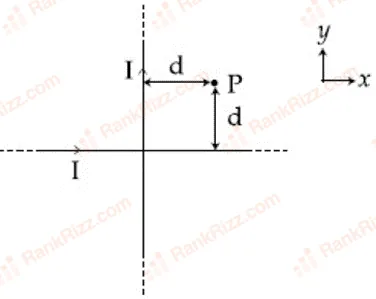
Two very long, straight, and insulated wires are kept at 90° angle from each other in xy-plane as shown in figure. These wires carry currents of equal magnitude I, whose direction are shown in the figure. The net magnetic field at point P will be:

Zero
A square loop is carrying a steady current I and the magnitude of its magnetic dipole moment is m. If this square loop is changed to a circular loop and it carries the same current, the magnitude of the magnetic dipole moment of circular loop will be:
An insulating thin rod of length has a linear charge density on it. The rod is rotated about an axis passing through the origin () and perpendicular to the rod. If the rod makes rotations per second, then the time averaged magnetic moment of the rod is:
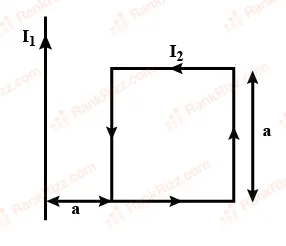
A rigid square loop of side 'a' and carrying current is lying on a horizontal surface near a long current carrying wire in the same plane as shown in figure. The net force on the loop due to the wire will be:

Attractive and equal to
Repulsive and equal to
Zero
A thin ring of 10 cm radius carries a uniformly distributed charge. The ring rotates at a constant angular speed of rad s about its axis, perpendicular to its plane. If the magnetic field at its centre is T, then the charge carried by the ring is close to N/A.
C
C
C
C
A moving coil galvanometer has a coil with 175 turns and area 1 cm. It uses a torsion band of torsion constant N m/rad. The coil is placed in a magnetic field B parallel to its plane. The coil deflects by 1° for a current of 1 mA. The value of B (in tesla) is approximately:
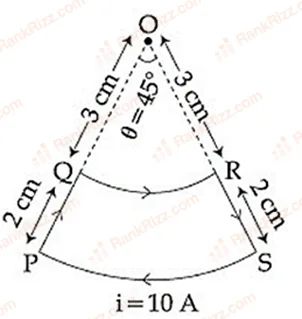
A current loop, having two circular arcs joined by two radial lines is shown in the figure. It carries a current of 10 A. The magnetic field at point O will be close to:

T
T
T
T
The magnitude of the magnetic field at the centre of an equilateral triangular loop of side 1 m which is carrying a current of 10 A is:
[Take N A]
3 μT
1 μT
18 μT
9 μT
A rectangular coil (Dimension 5 cm 2.5 cm) with 100 turns, carrying a current of 3 A in the clock-wise direction, is kept centered at the origin and in the X-Z plane. A magnetic field of 1 T is applied along X-axis. If the coil is tilted through 45° about Z-axis, then the torque on the coil is:
0.42 N m
0.55 N m
0.38 N m
0.27 N m
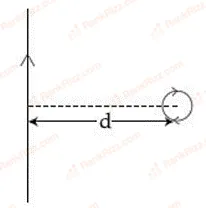
An infinitely long current carrying wire and a small current carrying loop are in the plane of the paper as shown. The radius of the loop is and distance of its centre from the wire is (). If the loop applies a force on the wire then:

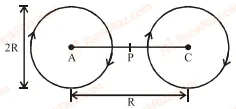
A Helmholtz coil has pair of loops, each with N turns and radius R. They are placed coaxially at distance R and the same current I flows through the loops in the same direction. The magnitude of magnetic field at P, midway between the centres A and C, is given by (Refer to figure):
The dipole moment of a circular loop carrying a current I, is m and the magnetic field at the centre of the loop is . When the dipole moment is doubled by keeping the current constant, the magnetic field at the centre of the loop is . The ratio is:
2
A current of 1 A is flowing on the sides of an equilateral triangle of side m. The magnetic field at the centre of the triangle will be:
Wb/m
Zero
Wb/m
Wb/m
A charge q is spread uniformly over an insulated loop of radius r. If it is rotated with an angular velocity with respect to normal axis then magnetic moment of the loop is:
An electron, a proton and an alpha particle having the same kinetic energy are moving in circular orbits of radii , , respectively in a uniform magnetic field B. The relation between , , is:
r_e < r_\alpha < r_p
r_e > r_P = r_\alpha
r_e < r_p = r_\alpha
r_e < r_p < r_\alpha
A negative test charge is moving near a long straight wire carrying a current. The force acting on the test charge is parallel to the direction of the current. The motion of the charge is:
Away from the wire
Towards the wire
Parallel to the wire along the current
Parallel to the wire opposite to the current
OTHER PHYSICS CHAPTERS