JEE Main 2012 Physics question — Stress, strain, Hooke's law and Young's modulus
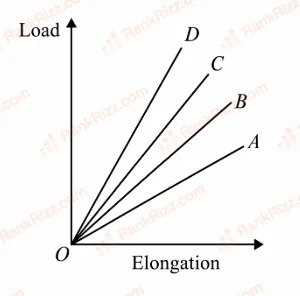
The load versus elongation graphs for four wires of same length and made of the same material are shown in the figure. The thinnest wire is represented by the line
SOLUTION
For a uniform wire of length , cross-sectional area and Young’s modulus , the elongation produced by a stretching force (load) is
Equation can be rearranged to write the load in terms of the elongation:
In a load-elongation graph, the slope is
For wires made of the same material ( common) and having the same length ( common), the slope is directly proportional to the cross-sectional area :
Therefore:
- A larger slope corresponds to a larger area (thicker wire).
- A smaller slope corresponds to a smaller area (thinner wire).
Among the four straight lines shown, line has the smallest slope (it rises the least in load for a given elongation). Hence, represents the wire with the smallest cross-sectional area, i.e., the thinnest wire.
Option A which is:
Tagged Stress, strain, Hooke's law and Young's modulus. Machine-assigned, so read it as a strong shortlist rather than a verdict.