RankRizz
JEE MAIN 2012TRANSCRIBED

JEE Main 2012 Physics question — Speed of efflux and applications of Bernoulli's theorem

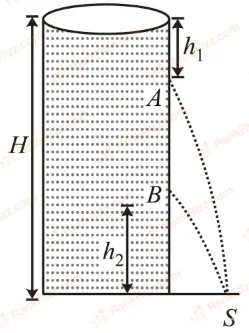
In a cylindrical water tank, there are two small holes AA and BB on the wall at a depth of h1h_1, from the surface of water and at a height of h2h_2 from the bottom of water tank. Surface of water is at height h2h_2 from the bottom of water tank. Surface of water is at height HH from the bottom of water tank. Water coming out from both holes strikes the ground at the same point SS. Find the ratio of h1h_1 and h2h_2.

Figure for JEE Main 2012 Physics question on Speed of efflux and applications of Bernoulli's theorem
SOLUTION

The horizontal range of water exiting a hole in a tank is given by R=2hdepth⋅hheightR = 2\sqrt{h_{\text{depth}} \cdot h_{\text{height}}}.

Given: For hole A: depth=h1,height=H−h1\text{depth} = h_1,\quad \text{height} = H - h_1

For hole B: height=h2,depth=H−h2\text{height} = h_2,\quad \text{depth} = H - h_2

Equating the horizontal ranges (RA=RBR_A = R_B):

2h1(H−h1)=2(H−h2)h22\sqrt{h_1(H - h_1)} = 2\sqrt{(H - h_2)h_2}

h1H−h12=h2H−h22h_1H - h_1^2 = h_2H - h_2^2

H(h1−h2)=h12−h22H(h_1 - h_2) = h_1^2 - h_2^2

H(h1−h2)=(h1−h2)(h1+h2)H(h_1 - h_2) = (h_1 - h_2)(h_1 + h_2)

Since the two holes are at different locations (h1≠h2h_1 \neq h_2):

H=h1+h2  ⟹  h1=H−h2H = h_1 + h_2 \implies h_1 = H - h_2

h1h2=H−h2h2=Hh2−1\frac{h_1}{h_2} = \frac{H - h_2}{h_2} = \frac{H}{h_2} - 1

Tagged Speed of efflux and applications of Bernoulli's theorem. Machine-assigned, so read it as a strong shortlist rather than a verdict.

SubjectPhysics
TopicSpeed of efflux and applications of Bernoulli's theorem
TypeMultiple choice