JEE Main 2024 Physics question — Speed of efflux and applications of Bernoulli's theorem
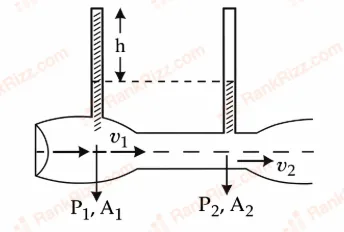
Given below are two statements: Statement I: When speed of liquid is zero everywhere, pressure difference at any two points depends on equation . Statement II: In venturi tube shown, . Choose the most appropriate answer from the options given below.
SOLUTION
Statement I:
When the speed of liquid is zero everywhere, the fluid is in hydrostatic condition. In this case, pressure variation depends only on depth. The relation between pressure difference and height difference is given by:
This is the standard hydrostatic pressure relation, so Statement I is correct.
Statement II:
In a venturi tube, fluid is flowing, so Bernoulli’s equation must be applied:
From Bernoulli’s equation:
Also, from the manometer height difference:
Combining these gives:
But in the statement it is given as:
which has the wrong sign.
Hence, Statement II is incorrect.
Tagged Speed of efflux and applications of Bernoulli's theorem. Machine-assigned, so read it as a strong shortlist rather than a verdict.