A body of mass 2 kg slides down with an acceleration of 3 m/s on a rough inclined plane having a slope of 30. The external force required to take the same body up the plane with the same acceleration will be: (g = 10 m/s)
- A
4 N
- B
14 N
- C
6 N
- D
20 N
Every Laws of Motion & Friction question JEE Main has set, grouped by the idea it tests rather than the order of the syllabus. 151 questions across 5 distinct ideas. Free to read, answer key on every one.
Questions
151
Distinct ideas
5
Share of marks
3%
Difficulty
MEDIUM
A chapter is not one subject — it is a handful of procedures the examiner reuses. These are the ones Laws of Motion & Friction questions actually test.
121–140 OF 151 · NEWEST FIRST
A body of mass 2 kg slides down with an acceleration of 3 m/s on a rough inclined plane having a slope of 30. The external force required to take the same body up the plane with the same acceleration will be: (g = 10 m/s)
4 N
14 N
6 N
20 N
A given object takes n times more time to slide down a 45 rough inclined plane as it takes to slide down a perfectly smooth 45 incline. The coefficient of kinetic friction between the object and the incline is:
A body of mass kg is moving in a medium and experiences a frictional force . Its initial speed is m s. After 10 s its kinetic energy is , then the value of will be:
kg m s
kg m
kg m s
kg m
A rocket is fired vertically from the earth with an acceleration of 2g, where g is the gravitational acceleration. On an inclined plane inside the rocket, making an angle with the horizontal, a point object of mass m is kept. The minimum coefficient of friction between the mass and the inclined surface such that the mass does not move is:
A particle of mass is acted upon by a force given by the empirical law . If this law is to be tested experimentally by observing the motion starting from rest, the best way is to plot
against
against
against
against
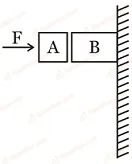
Given in the figure are two blocks A and B of weight 20 N and 100 N, respectively. These are being pressed against a wall by a force F and kept in equilibrium as shown. If the coefficient of friction between the blocks is 0.1 and between block B and the wall is 0.15, the frictional force applied by the wall on block B is:
150 N
100 N
80 N
120 N
A heavy box is to be dragged along a rough horizontal floor. To do so, the person A pushes it at an angle 30° from the horizontal and requires a minimum force , while the person B pulls the box at an angle 60° from the horizontal and needs minimum force . If the coefficient of friction between the box and the floor is , the ratio is:
A block of mass is placed on a surface with a vertical cross section given by . If the coefficient of friction is 0.5, the maximum height above the ground at which the block can be placed without slipping is:
m
m
m
m
Water is flowing at a speed of 1.5 m s through a horizontal tube of cross-sectional area m and you are trying to stop the flow by your palm. Assuming that the water stops immediately after hitting the palm, the minimum force that you must exert should be (density of water = kg m)
33.7 N
45 N
15 N
22.5 N
A body of mass 5 kg under the action of constant force has velocity at t = 0 s as m/s and at t = 10 s as m/s. The force is:
N
N
N
N
A block A of mass 4 kg is placed on another block B of mass 5 kg, and the block B rests on a smooth horizontal table. If the minimum force that can be applied on A so that both the blocks move together is 12 N, the maximum force that can be applied on B for the blocks to move together will be:
0 N
25 N
48 N
27 N
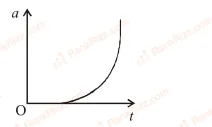
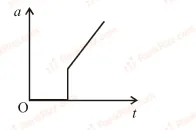
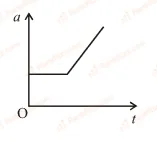
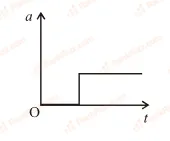
A block is placed on a rough horizontal plane. A time dependent horizontal force acts on the block, where k is a positive constant. The acceleration - time graph of the block is :


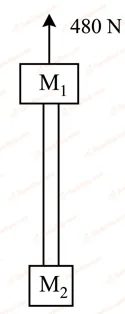
Two blocks of mass kg and kg are connected by a metal rod of mass 8 kg. The system is pulled vertically up by applying a force of 480 N as shown. The tension at the mid-point of the rod is:

144 N
96 N
240 N
192 N
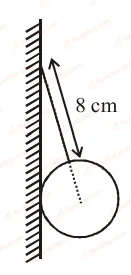
A uniform sphere of weight W and radius 5 cm is being held by a string as shown in the figure. The tension in the string will be :

A body starts from rest on a long inclined plane of slope 45°. The coefficient of friction between the body and the plane varies as , where x is distance travelled down the plane. The body will have maximum speed (for m/s) when =
9.8 m
27 m
12 m
3.33 m
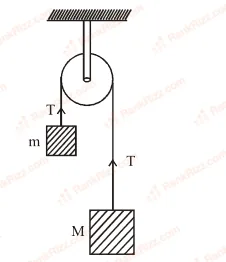
Two blocks of masses m and M are connected by means of a metal wire of cross-sectional area A passing over a frictionless fixed pulley as shown in the figure. The system is then released. If M = 2m, then the stress produced in the wire is:

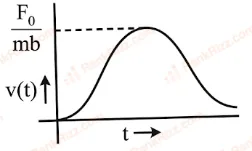
A particle of mass is at rest at the origin at time . It is subjected to a force in the direction. Its speed is depicted by which of the following curves?


A car of mass 1000 kg is moving at a speed of . Brakes are applied to bring the car to rest. If the net retarding force is , the car comes to stop after travelling m in s. Then
This question has Statement 1 and Statement 2. Of the four choices given after the Statements, choose the one that best describes the two Statements.
Statement 1: If you push on a cart being pulled by a horse so that it does not move, the cart pushes you back with an equal and opposite force.
Statement 2: The cart does not move because the force described in statement 1 cancel each other.
Statement 1 is true, Statement 2 is true, Statement 2 is the correct explanation of Statement 1.
Statement 1 is false, Statement 2 is true.
Statement 1 is true, Statement 2 is false.
Statement 1 is true, Statement 2 is true, Statement 2 is not the correct explanation of Statement 1.
A block of weight rests on a horizontal floor with coefficient of static friction . It is desired to make the block move by applying minimum amount of force. The angle from the horizontal at which the force should be applied and magnitude of the force are respectively.
OTHER PHYSICS CHAPTERS