RankRizzStart free

Mechanical Properties of Fluids — JEE Main Previous Year Questions

Every Mechanical Properties of Fluids question JEE Main has set, grouped by the idea it tests rather than the order of the syllabus. 193 questions across 9 distinct ideas. Free to read, answer key on every one.

Questions

193

Distinct ideas

9

Share of marks

4.2%

Difficulty

MEDIUM

The ideas inside Mechanical Properties of Fluids

A chapter is not one subject — it is a handful of procedures the examiner reuses. These are the ones Mechanical Properties of Fluids questions actually test.

01Fluid pressure, Pascal's law and accelerated/rotating liquidsset 24×
02Archimedes' principle and floatationset 16×
03Equation of continuity and Bernoulli's theoremset 20×
04Speed of efflux and applications of Bernoulli's theoremset 21×
05Viscosity, Poiseuille's equation and Reynolds numberset 11×
06Stokes' law and terminal velocityset 34×
07Surface tension and surface energyset 28×
08Excess pressure in drops and bubblesset 20×
09Angle of contact and capillary riseset 19×

Every Mechanical Properties of Fluids question

181–193 OF 193 · NEWEST FIRST

JEE MAIN 2012Speed of efflux and applications of Bernoulli's theoremTRANSCRIBED

In a cylindrical water tank, there are two small holes and on the wall at a depth of , from the surface of water and at a height of from the bottom of water tank. Surface of water is at height from the bottom of water tank. Surface of water is at height from the bottom of water tank. Water coming out from both holes strikes the ground at the same point . Find the ratio of and .
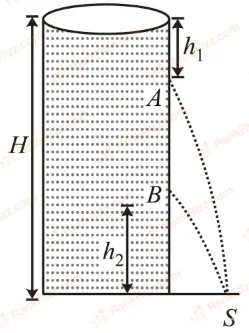
image
  1. A

    Depends on

  2. B

  3. C

  4. D

JEE MAIN 2012Surface tension and surface energyTRANSCRIBED

A large number of droplets, each of radius coalesce to form a bigger drop of radius . An engineer designs a machine so that the energy released in this process is converted into the kinetic energy of the drop. Velocity of the drop is ( = surface tension, = density)

  1. A

  2. B

  3. C

  4. D

JEE MAIN 2012Equation of continuity and Bernoulli's theoremTRANSCRIBED

Water is flowing through a horizontal tube having cross-sectional areas of its two ends being and such that the ratio is . If the pressure difference of water between the two ends is N m, the velocity of water with which it enters the tube will be (neglect gravity effects)

  1. A

    m s

  2. B

    m s

  3. C

    m s

  4. D

    m s

JEE MAIN 2011Surface tension and surface energyTRANSCRIBED

Work done in increasing the size of a soap bubble from a radius of to is nearly (Surface tension of soap solution ):

  1. A

  2. B

  3. C

  4. D

JEE MAIN 2011Equation of continuity and Bernoulli's theoremTRANSCRIBED

Water is flowing continuously from a tap having an internal diameter . The water velocity as it leaves the tap is . The diameter of the water stream at a distance below the tap is close to:

  1. A

  2. B

  3. C

  4. D

JEE MAIN 2010Archimedes' principle and floatationTRANSCRIBED

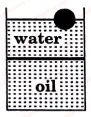
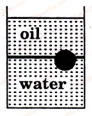
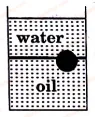
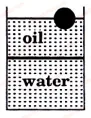
A ball is made of a material of density where \rho_{\text{oil}} < \rho < \rho_{\text{water}} with and representing the densities of oil and water, respectively. The oil and water are immiscible. If the above ball is in equilibrium in a mixture of this oil and water, which of the following pictures represents its equilibrium position?

  1. A
  2. B
  3. C
  4. D
JEE MAIN 2008Stokes' law and terminal velocityTRANSCRIBED

A spherical solid ball of volume is made of a material of density . It is falling through a liquid of density \rho_2\ (\rho_2 < \rho_1). Assume that the liquid applies a viscous force on the ball that is proportional to the square of its speed v, i.e., F_{viscous} = -kv^2 (k > 0). The terminal speed of the ball is

  1. A

  2. B

  3. C

  4. D

JEE MAIN 2008Archimedes' principle and floatationTRANSCRIBED

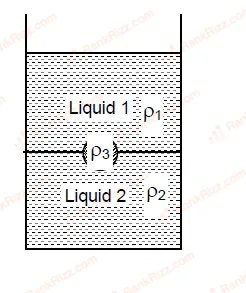
A jar filled with two non mixing liquids 1 and 2 having densities and respectively. A solid ball, made of a material of density , is dropped in the jar. It comes to equilibrium in the position shown in the figure. Which of the following is true for and ?

  1. A

    \rho_3 < \rho_1 < \rho_2

  2. B

    \rho_1 < \rho_3 < \rho_2

  3. C

    \rho_1 < \rho_2 < \rho_3

  4. D

    \rho_3 < \rho_2 < \rho_1

JEE MAIN 2008Angle of contact and capillary riseTRANSCRIBED

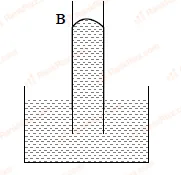
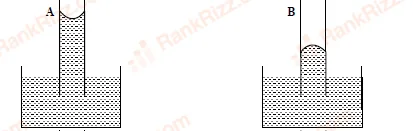
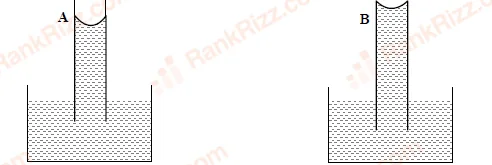
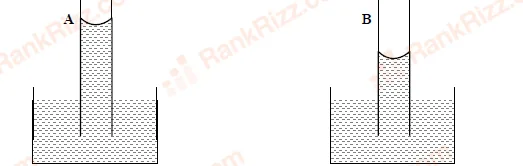
A capillary tube (A) is dropped in water. Another identical tube (B) is dipped in a soap water solution. Which of the following shows the relative nature of the liquid columns in the two tubes?

  1. A
  2. B
  3. C
  4. D
JEE MAIN 2006Stokes' law and terminal velocityTRANSCRIBED

If the terminal speed of a sphere of gold (density ) is in a viscous liquid (density ) of the same size in the same liquid.

  1. A

    0.2 m/s

  2. B

    0.4 m/s

  3. C

    0.133 m/s

  4. D

    0.1 m/s

JEE MAIN 2005Angle of contact and capillary riseTRANSCRIBED

A cm long capillary tube is dipped in water. The water rises up to cm. If the entire arrangement is put in a freely falling elevator the length of water column in the capillary tube will be

  1. A

    cm

  2. B

    cm

  3. C

    cm

  4. D

    cm

JEE MAIN 2004Stokes' law and terminal velocityTRANSCRIBED

Spherical balls of radius are falling in a viscous fluid of viscosity with a velocity . The retarding viscous force acting on the spherical ball is

  1. A

    directly proportional to but inversely proportional to .

  2. B

    directly proportional to both radius and velocity .

  3. C

    inversely proportional to both radius and velocity .

  4. D

    inversely proportional to but directly proportional to velocity .

JEE MAIN 2004Excess pressure in drops and bubblesTRANSCRIBED

If two soap bubbles of different radii are connected by a tube,

  1. A

    air flows from the bigger bubble to the smaller bubble till the sizes are interchanged.

  2. B

    air flows from bigger bubble to the smaller bubble till the sizes are interchanged

  3. C

    air flows from the smaller bubble to the bigger.

  4. D

    there is no flow of air.