RankRizz

Electromagnetic spectrum and uses — JEE Main Previous Year Questions

Every JEE Main question on Electromagnetic spectrum and uses, one of the ideas inside Electromagnetic Waves: 28 questions from 2010–2026, 13 of them in the last five years. Newest first, answer key on every one. Free to read.

Questions

28

Years asked

13

Since

2010

Of the chapter

15%

When JEE Main asked it

Questions on Electromagnetic spectrum and uses in each year it was asked, the latest 12 of 13.

20261
20251
20243
20235
20223
20211
20202
20182
20162
20144
20132
20121

Every Electromagnetic spectrum and uses question

1–20 OF 28 · NEWEST FIRST

JEE MAIN 2026 · 24 JAN S1Electromagnetic spectrum and usesTRANSCRIBED

Match the LIST-I with LIST-II
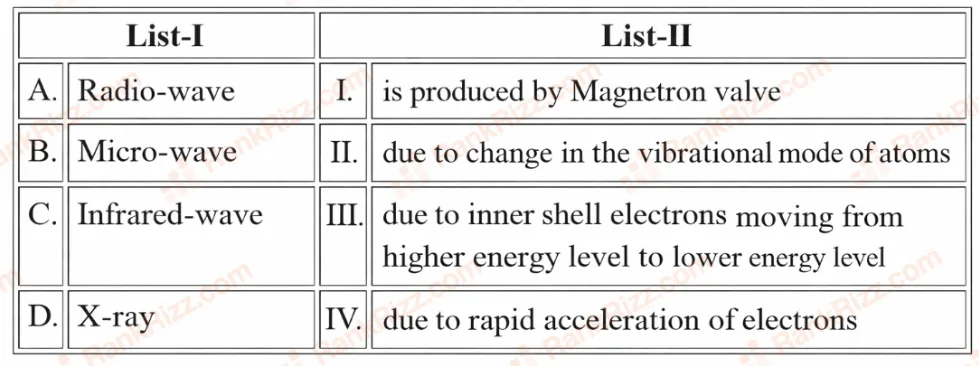
24th slot 1 33


Choose the correct answer from the options given below:

  1. A

    A-IV, B-III, C-I, D-II

  2. B

    A-IV, B-II, C-I, D-III

  3. C

    A-IV, B-I, C-II, D-III

  4. D

    A-II, B-IV, C-III, D-I

JEE MAIN 2025 · 24 JAN S2Electromagnetic spectrum and usesTRANSCRIBED

Arrange the following in the ascending order of wavelength (λ)(\lambda) : (A) Microwaves (λ1)(\lambda_1)(B) Ultraviolet rays (λ2)(\lambda_2) (C) Infrared rays (λ3)(\lambda_3) (D) X-rays (λ4)(\lambda_4) Choose the most appropriate answer from the options given below

  1. A

    λ4<λ3<λ2<λ1\lambda_4 < \lambda_3 < \lambda_2 <\lambda_1

  2. B

    λ3<λ4<λ2<λ1\lambda_3 < \lambda_4 < \lambda_2 <\lambda_1

  3. C

    λ4<λ3<λ1<λ2\lambda_4 < \lambda_3 < \lambda_1 <\lambda_2

  4. D

    λ4<λ2<λ3<λ1\lambda_4 < \lambda_2 < \lambda_3 <\lambda_1

JEE MAIN 2024 · 05 APR S2Electromagnetic spectrum and usesTRANSCRIBED

Match List-I with List-II :

Figure for JEE Main 2024 Physics question on Electromagnetic spectrum and uses

Choose the correct answer from the options given below :

  1. A

    (A)-(IV), (B)-(II), (C)-(III), (D)-(I)

  2. B

    (A)-(III), (B)-(IV), (C)-(I), (D)-(II)

  3. C

    (A)-(II), (B)-(IV), (C)-(I), (D)-(III)

  4. D

    (A)-(III), (B)-(I), (C)-(II), (D)-(IV)

JEE MAIN 2024 · 04 APR S2Electromagnetic spectrum and usesTRANSCRIBED

Arrange the following in the ascending order of wavelength: A. Gamma rays (λ1)(\lambda_1), B. x-rays (λ2)(\lambda_2), C. Infrared waves (λ3)(\lambda_3), D. Microwaves (λ4)(\lambda_4). Choose the most appropriate answer from the options given below:

  1. A

    λ4<λ3<λ1<λ2\lambda_4 < \lambda_3 < \lambda_1 < \lambda_2

  2. B

    λ2<λ1<λ4<λ3\lambda_2 < \lambda_1 < \lambda_4 < \lambda_3

  3. C

    λ1<λ2<λ3<λ4\lambda_1 < \lambda_2 < \lambda_3 < \lambda_4

  4. D

    λ4<λ3<λ2<λ1\lambda_4 < \lambda_3 < \lambda_2 < \lambda_1

JEE MAIN 2024 · 05 APR S2Electromagnetic spectrum and usesTRANSCRIBED

Match List-I with List-II :

Figure for JEE Main 2024 Physics question on Electromagnetic spectrum and uses
  1. A

    (A)-(III), (B)-(II), (C)-(IV), (D)-(I)

  2. B

    (A)-(II), (B)-(I), (C)-(IV), (D)-(III)

  3. C

    (A)-(IV), (B)-(III), (C)-(II), (D)-(I)

  4. D

    (A)-(I), (B)-(III), (C)-(II), (D)-(IV)

JEE MAIN 2023 · 12 APR S1Electromagnetic spectrum and usesTRANSCRIBED

Given below are two statements: one is labelled as Assertion A and the other is labelled as Reason R.
Assertion A : EM waves used for optical communication have longer wavelengths than that of microwave, employed in Radar technology.
Reason R : Infrared EM waves are more energetic than microwaves, (used in Radar)
In the light of above, statements, choose the correct answer from the options given below.

  1. A

    Both A and R are true but R is NOT the correct explanation of A

  2. B

    A is false but R is true

  3. C

    A is true but R is false

  4. D

    Both A and R are true and R is the correct explanation of A

JEE MAIN 2023 · 31 JAN S2Electromagnetic spectrum and usesTRANSCRIBED

Match List I and List II
List I                    List II
A. Microwaves       I. Physiotherapy
B. UV rays               II. Treatment of cancer
C. Infra-red rays     III. Lasik eye surgery
D. X-rays                  IV. Aircraft navigation
Choose the correct answer from the option given below:

  1. A

    A-II, B-IV, C-III, D-I

  2. B

    A-IV, B-I, C-II, D-III

  3. C

    A-IV, B-III, C-I, D-II

  4. D

    A-III, B-II, C-I, D-IV

JEE MAIN 2023 · 08 APR S2Electromagnetic spectrum and usesTRANSCRIBED

The waves emitted when a metal target is bombarded with high energy electrons are

  1. A

    Microwaves

  2. B

    Infrared rays

  3. C

    X-rays

  4. D

    Radio Waves

JEE MAIN 2023 · 01 FEB S1Electromagnetic spectrum and usesTRANSCRIBED

Match the List-I with List-II:
A. Microwaves   I. Radioactive decay of the nucleus
B. Gamma rays   II. Rapid acceleration and deceleration of electron in aerials
C. Radio waves   III. Inner shell electrons
D. X-rays   IV. Klystron valve

  1. A

    A-I, B-II, C-III, D-IV

  2. B

    A-IV, B-I, C-II, D-III

  3. C

    A-I, B-III, C-IV, D-II

  4. D

    A-IV, B-III, C-II, D-I

JEE MAIN 2023 · 15 APR S1Electromagnetic spectrum and usesTRANSCRIBED

Match List-I with List II of Electromagnetic waves with corresponding wavelength range:

List IList II
AMicrowaveI400 nm to 1 nm
BUltravioletII1 nm to 10−310^{-3} nm
CX-RayIII1 mm to 700 nm
DInfra-redIV0.1 m to 1 mm

Choose the correct answer from the options given below:
  1. A

    (A)-(IV), (B)-(I), (C)-(II), (D)-(III)

  2. B

    (A)-(IV), (B)-(I), (C)-(III), (D)-(II)

  3. C

    (A)-(IV), (B)-(II), (C)-(I), (D)-(III)

  4. D

    (A)-(I), (B)-(IV), (C)-(II), (D)-(III)

JEE MAIN 2022 · 29 JUL S1Electromagnetic spectrum and usesTRANSCRIBED

Match List-I with List-II

List-IList-II
(a) UV rays(i) Diagnostic tool in medicine
(b) X-rays(ii) Water purification
(c) Microwave(iii) Communication, Radar
(d) Infrared wave(iv) Improving visibility in foggy days

Choose the correct answer from the options given below :

  1. A

    (a)-(iii), (b)-(ii), (c)-(i), (d)-(iv)

  2. B

    (a)-(ii), (b)-(i), (c)-(iii), (d)-(iv)

  3. C

    (a)-(ii), (b)-(iv), (c)-(iii), (d)-(i)

  4. D

    (a)-(iii), (b)-(i), (c)-(ii), (d)-(iv)

JEE MAIN 2022 · 27 JUN S1Electromagnetic spectrum and usesTRANSCRIBED

Match List - I with List - II

List-IList-II
(a) Ultraviolet rays(i) Study crystal structure
(b) Microwaves(ii) Greenhouse effect
(c) Infrared waves(iii) Sterilizing surgical instrument
(d) X-rays(iv) Radar system
  1. A

    (a)-(iii), (b)(iv), (c)-(ii), (d)-(i)

  2. B

    (a)-(iii), (b)(i), (c)-(ii), (d)-(iv)

  3. C

    (a)-(iv), (b)(iii), (c)-(ii), (d)-(i)

  4. D

    (a)-(iii), (b)(iv), (c)-(i), (d)-(ii)

JEE MAIN 2022 · 26 JUN S2Electromagnetic spectrum and usesTRANSCRIBED

Which is the correct ascending order of wavelengths?

  1. A

    λvisible<λX−ray<λgamma−ray<λmicrowave\lambda_{visible} < \lambda_{X-ray} < \lambda_{gamma-ray} < \lambda_{microwave}

  2. B

    λgamma−ray<λX−ray<λvisible<λmicrowave\lambda_{gamma-ray} < \lambda_{X-ray} < \lambda_{visible} < \lambda_{microwave}

  3. C

    λX−ray<λgamma−ray<λvisible<λmicrowave\lambda_{X-ray} < \lambda_{gamma-ray} < \lambda_{visible} < \lambda_{microwave}

  4. D

    λmicrowave<λvisible<λgamma−ray<λX−ray\lambda_{microwave} < \lambda_{visible} < \lambda_{gamma-ray} < \lambda_{X-ray}

JEE MAIN 2021 · 24 FEB S2Electromagnetic spectrum and usesTRANSCRIBED

Match List - I with List - II.

List-IList-II
(a) Source of microwave frequency(i) Radioactive decay of nucleus
(b) Source of infrared frequency(ii) Magnetron
(c) Source of Gamma Rays(iii) Inner shell electrons
(d) Source of X-rays(iv) Vibration of atoms and molecules
(v) LASER
(vi) RC circuit

Choose the correct answer from the options given below:
  1. A

    (a)-(ii), (b)-(iv), (c)-(vi), (d)-(iii)

  2. B

    (a)-(vi), (b)-(iv), (c)-(i), (d)-(v)

  3. C

    (a)-(vi), (b)-(v), (c)-(i), (d)-(iv)

  4. D

    (a)-(ii), (b)-(iv), (c)-(i), (d)-(iii)

JEE MAIN 2020 · 04 SEP S1Electromagnetic spectrum and usesTRANSCRIBED

Choose the correct option relating wavelengths of different parts of electromagnetic wave spectrum:

  1. A

    λvisible<λmicrowaves<λradiowaves<λx−rays\lambda_{visible} < \lambda_{microwaves} < \lambda_{radiowaves} < \lambda_{x-rays}

  2. B

    λradiowaves>λmicrowaves>λvisible>λx−rays\lambda_{radiowaves} > \lambda_{microwaves} > \lambda_{visible} > \lambda_{x-rays}

  3. C

    λx−rays<λmicrowaves<λradiowaves<λvisible\lambda_{x-rays} < \lambda_{microwaves} < \lambda_{radiowaves} < \lambda_{visible}

  4. D

    λvisible>λx−rays>λradiowaves>λmicrowaves\lambda_{visible} > \lambda_{x-rays} > \lambda_{radiowaves} > \lambda_{microwaves}

JEE MAIN 2020 · 05 SEP S2Electromagnetic spectrum and usesTRANSCRIBED

The correct match between the entries in column I and column II are:
I (Radiation)               II (Wavelength)
a. Microwave               i. 100 m
b. Gamma rays            ii. 10−1510^{-15} m
c. A.M. radio                iii. 10−1010^{-10} m
d. X-rays                       iv. 10−310^{-3} m

  1. A

    (a)-(ii), (b)-(i), (c)-(iv), (d)-(iii)

  2. B

    (a)-(i), (b)-(iii), (c)-(iv), (d)-(ii)

  3. C

    (a)-(iii), (b)-(ii), (c)-(i), (d)-(iv)

  4. D

    (a)-(iv), (b)-(ii), (c)-(i), (d)-(iii)

JEE MAIN 2018 · 08 APR OFFLINEElectromagnetic spectrum and usesTRANSCRIBED

An EM wave from air enters a medium. The electric fields are E1⃗=E01x^cos⁡[2πν(zc−t)]\vec{E_1} = E_{01}\hat{x}\cos\left[2\pi\nu\left(\frac{z}{c} - t\right)\right] in air and E2⃗=E02x^cos⁡[k(2z−ct)]\vec{E_2} = E_{02}\hat{x}\cos[k(2z - ct)] in medium, where the wave number k and frequency ν\nu refer to their values in the air. The medium is non-magnetic. If ϵr1\epsilon_{r_1} and ϵr2\epsilon_{r_2} refer to relative permittivities of air and medium respectively, which of the following options is correct?

  1. A

    ϵr1ϵr2=12\frac{\epsilon_{r_1}}{\epsilon_{r_2}} = \frac{1}{2}

  2. B

    ϵr1ϵr2=4\frac{\epsilon_{r_1}}{\epsilon_{r_2}} = 4

  3. C

    ϵr1ϵr2=2\frac{\epsilon_{r_1}}{\epsilon_{r_2}} = 2

  4. D

    ϵr1ϵr2=14\frac{\epsilon_{r_1}}{\epsilon_{r_2}} = \frac{1}{4}

JEE MAIN 2018 · 08 APR OFFLINEElectromagnetic spectrum and usesTRANSCRIBED

A telephonic communication service is working at a carrier frequency of 10 GHz. Only 10% of it is utilized for transmission. How many telephonic channels can be transmitted simultaneously if each channel requires a bandwidth of 5 kHz?

  1. A

    2×1062 \times 10^6

  2. B

    2×1032 \times 10^3

  3. C

    2×1042 \times 10^4

  4. D

    2×1052 \times 10^5

JEE MAIN 2016 · 03 APR OFFLINEElectromagnetic spectrum and usesTRANSCRIBED

Arrange the following electromagnetic radiations per quantum in the order of increasing energy:
A: Blue light
B: Yellow light
C: X-ray
D: Radiowave

  1. A

    C, A, B, D

  2. B

    B, A, D, C

  3. C

    D, B, A, C

  4. D

    A, B, D, C

JEE MAIN 2016 · 09 APR ONLINEElectromagnetic spectrum and usesTRANSCRIBED

Microwave oven acts on the principle of:

  1. A

    giving rotational energy to water molecules

  2. B

    giving translational energy to water molecules

  3. C

    giving vibrational energy to water molecules

  4. D

    transferring electrons from lower to higher energy levels in water molecule