RankRizzStart free

Dual Nature of Radiation & Matter — JEE Main Previous Year Questions

Every Dual Nature of Radiation & Matter question JEE Main has set, grouped by the idea it tests rather than the order of the syllabus. 216 questions across 4 distinct ideas. Free to read, answer key on every one.

Questions

216

Distinct ideas

4

Share of marks

3.4%

Difficulty

MEDIUM

The ideas inside Dual Nature of Radiation & Matter

A chapter is not one subject — it is a handful of procedures the examiner reuses. These are the ones Dual Nature of Radiation & Matter questions actually test.

01Photons: energy, momentum and radiation pressureset 29×
02Photoelectric effect and Einstein's equationset 98×
03de Broglie wavelength of matter wavesset 82×
04Davisson-Germer experimentset 7×

Every Dual Nature of Radiation & Matter question

141–160 OF 216 · NEWEST FIRST

JEE MAIN 2021 · 26 FEB S2Photoelectric effect and Einstein's equationTRANSCRIBED

Two stream of photons, possessing energies equal to twice and ten times the work function of metal are incident on the metal surface successively. The value of ratio of maximum velocities of the photoelectrons emitted in the two respective cases is . The value of is
JEE MAIN 2021 · 25 FEB S2Photons: energy, momentum and radiation pressureTRANSCRIBED

The wavelength of an X-ray beam is 10 Å. The mass of a fictitious particle having the same energy as that of the X-ray photons is kg. The value of is ______. ( = Planck's constant)

JEE MAIN 2020 · 06 SEP S2de Broglie wavelength of matter wavesTRANSCRIBED

Assuming the nitrogen molecule is moving with r.m.s. velocity at 400 K, the de-Broglie wave length of nitrogen molecule is close to: (Given: nitrogen molecule weight: , Boltzman constant: , Planck constant: )

  1. A

  2. B

  3. C

  4. D

JEE MAIN 2020 · 09 JAN S1Photoelectric effect and Einstein's equationTRANSCRIBED

Radiation, with wavelength Å falls on a metal surface to produce photoelectrons. The electrons are made to enter a uniform magnetic field of T. If the radius of the largest circular path followed by the electrons is mm, the work function of the metal is close to:

  1. A

    1.6 eV

  2. B

    0.8 eV

  3. C

    1.1 eV

  4. D

    1.8 eV

JEE MAIN 2020 · 03 SEP S1Photoelectric effect and Einstein's equationTRANSCRIBED

When the wavelength of radiation falling on a metal is changed from 500 nm to 200 nm, the maximum kinetic energy of the photoelectrons becomes three times larger. The work function of the metal is close to:

  1. A

    0.81 eV

  2. B

    1.02 eV

  3. C

    0.52 eV

  4. D

    0.61 eV

JEE MAIN 2020 · 03 SEP S2Photons: energy, momentum and radiation pressureTRANSCRIBED

Two sources of light emit X-rays of wavelength 1 nm and visible light of wavelength 500 nm, respectively. Both the sources emit light of the same power 200 W. The ratio of the number density of photons of X-rays to the number density of photons of the visible light of the given wavelengths is:

  1. A

  2. B

    250

  3. C

  4. D

    500

JEE MAIN 2020 · 06 SEP S1de Broglie wavelength of matter wavesTRANSCRIBED

An electron, a doubly ionized helium ion and proton are having the same kinetic energy. The relation between their respective de-Broglie wavelength , and is:

  1. A

    \lambda_e > \lambda_{He^{++}} > \lambda_p

  2. B

    \lambda_e < \lambda_{He^{++}} = \lambda_p

  3. C

    \lambda_e > \lambda_p > \lambda_{He^{++}}

  4. D

    \lambda_e < \lambda_p < \lambda_{He^{++}}

JEE MAIN 2020 · 09 JAN S2de Broglie wavelength of matter wavesTRANSCRIBED

An electron of mass and magnitude of charge at rest, gets accelerated by a constant electric field . The rate of change of de-Broglie wavelength of this electron at time is (ignore relativistic effects):

  1. A

  2. B

  3. C

  4. D

JEE MAIN 2020 · 04 SEP S1de Broglie wavelength of matter wavesTRANSCRIBED

Particle A of mass moving along the x-axis with velocity collides elastically with another particle B at rest having mass . If both particles move along the x-axis after the collision, the change in the wavelength of particle A, in terms of its de-Broglie wavelength before the collision is:

  1. A

  2. B

  3. C

  4. D

JEE MAIN 2020 · 08 JAN S1Photoelectric effect and Einstein's equationTRANSCRIBED

When photon of energy 4.0 eV strikes the surface of a metal A, the ejected photoelectrons have maximum kinetic energy eV and de-Broglie wavelength . The maximum kinetic energy of photoelectrons liberated from another metal B by photon of energy 4.50 eV is eV. If the de-Broglie wavelength of these photoelectrons , then the work function of metal B is:

  1. A

    4 eV

  2. B

    2 eV

  3. C

    1.5 eV

  4. D

    3 eV

JEE MAIN 2020 · 02 SEP S2de Broglie wavelength of matter wavesTRANSCRIBED

A particle is moving 5 times as fast as an electron. The ratio of the de-Broglie wavelength of the particle to that of the electron is . The mass of the particle is close to:

  1. A

    kg

  2. B

    kg

  3. C

    kg

  4. D

    kg

JEE MAIN 2020 · 04 SEP S2Photoelectric effect and Einstein's equationTRANSCRIBED

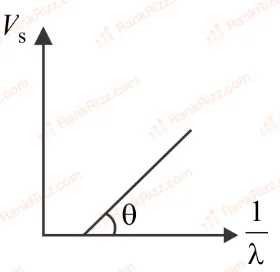
In a photoelectric effect experiment, the graph of stopping potential versus reciprocal of wavelength obtained is shown in the figure. As the intensity of incident radiation is increased:

image
  1. A

    Straight line shifts to right

  2. B

    Slope of the straight line get more steep

  3. C

    Straight line shifts to left

  4. D

    Graph does not change

JEE MAIN 2020 · 09 JAN S1de Broglie wavelength of matter wavesTRANSCRIBED

A particle moving with kinetic energy has de Broglie wavelength . If energy is added to its energy, the wavelength become . Value of , is:

  1. A

  2. B

  3. C

  4. D

JEE MAIN 2020 · 07 JAN S2de Broglie wavelength of matter wavesTRANSCRIBED

An electron (of mass ) and a photon have the same energy in the range of a few eV. The ratio of the de-Broglie wavelength associated with the electron and the wavelength of the photon is (c = speed of light in vacuum)

  1. A

  2. B

  3. C

  4. D

JEE MAIN 2020 · 04 SEP S1Photoelectric effect and Einstein's equationTRANSCRIBED

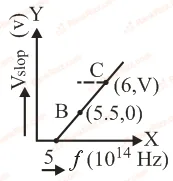
Given figure shows few data points in a photo-electric effect experiment for a certain metal. The minimum energy for ejection of electrons from its surface is: (Planck's constant h = 6.62 10 J.s)

  1. A

    2.27 eV

  2. B

    2.59 eV

  3. C

    1.93 eV

  4. D

    2.10 eV

JEE MAIN 2020 · 08 JAN S2de Broglie wavelength of matter wavesTRANSCRIBED

An electron (mass m) with initial velocity is in an electric field . If is initial de-Broglie wavelength of electron, its de-Broglie wave length at time is given by:

  1. A

  2. B

  3. C

  4. D

JEE MAIN 2020 · 07 JAN S1Photons: energy, momentum and radiation pressureTRANSCRIBED

A beam of electromagnetic radiation of intensity W/cm is comprised of wavelength, nm. It falls normally on a metal (work function eV) of surface area of 1 cm. If one in photons ejects an electron, total number of electrons ejected in 1s is . ( eVnm, eV J), then is

JEE MAIN 2020 · 05 SEP S1Davisson-Germer experimentTRANSCRIBED

A beam of electrons of energy scatters from a target having atomic spacing of . The first maximum intensity occurs at . Then (in eV) is......... (Planck's constant , , electron mass )

JEE MAIN 2020 · 05 SEP S2Photoelectric effect and Einstein's equationTRANSCRIBED

The surface of a metal is illuminated alternately with photons of energies and respectively. The ratio of maximum speeds of the photoelectrons emitted in the two cases is 2. The work function of the metal in (eV) is..........

JEE MAIN 2020 · 02 SEP S1Photoelectric effect and Einstein's equationTRANSCRIBED

When radiation of wavelength A is used to illuminate a metallic surface, the stopping potential is V. When the same surface is illuminated with radiation of wavelength 3A, the stopping potential is . If the threshold wavelength for the metallic surface is then value of n will be ___________.