Two billiard balls of mass each moving in opposite directions with collide and rebound with the same speed. If the time duration of contact is , then what is the force exerted on the ball due to each other?
- A
- B
- C
- D

Every Centre of Mass, Momentum & Collisions question JEE Main has set, grouped by the idea it tests rather than the order of the syllabus. 135 questions across 8 distinct ideas. Free to read, answer key on every one.
Questions
135
Distinct ideas
8
Share of marks
1.4%
Difficulty
MEDIUM
A chapter is not one subject — it is a handful of procedures the examiner reuses. These are the ones Centre of Mass, Momentum & Collisions questions actually test.
41–60 OF 135 · NEWEST FIRST
Two billiard balls of mass each moving in opposite directions with collide and rebound with the same speed. If the time duration of contact is , then what is the force exerted on the ball due to each other?
What percentage of kinetic energy of a moving particle is transferred to a stationary particle when it strikes the stationary particle of times its mass?
(Assume the collision to be head-on elastic collision)
A body of mass at rest explodes into three pieces, in the ratio of masses 1 : 1 : 2. Two smaller pieces fly off perpendicular to each other with velocities of 30 m s and 40 m s respectively. The velocity of the third piece will be
35 m s
50 m s
25 m s
15 m s
Two bodies of mass 1 kg and 3 kg have position vectors and respectively. The magnitude of position vector of centre of mass of this system will be similar to the magnitude of vector:
Three identical spheres each of mass are placed at the corners of a right angled triangle with mutually perpendicular sides equal to each. Taking point of intersection of mutually perpendicular sides as origin, the magnitude of position vector of centre of mass of the system will be m. The value of is ______.
A batsman hits back a ball of mass kg straight in the direction of the bowler without changing its initial speed of m s. The impulse imparted to the ball is ______ N s.
A man of kg is running on the road and suddenly jumps into a stationary trolly car of mass kg. Then the trolly car starts moving with velocity m s. The velocity of the running man was ______ m s, when he jumps into the car.
The distance of centre of mass from end A of a one dimensional rod (AB) having mass density kg m and length (in meter) is m. The value of is _____ (where is the distance from end A)
Two identical blocks and each of mass resting on the smooth horizontal floor are connected by a light spring of natural length and spring constant . A third block of mass moving with a speed along the line joining and collides with . The maximum compression in the spring is:

A bullet of 4 g mass is fired from a gun of mass 4 kg. If the bullet moves with the muzzle speed of 50 ms, the impulse imparted to the gun and velocity of recoil of gun are
0.4 kg m s, 0.1 m s
0.2 kg m s, 0.05 m s
0.2 kg m s, 0.1 m s
0.4 kg m s, 0.05 m s
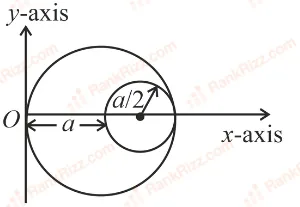
A circular hole of radius is cut out of a circular disc of radius as shown in figure. The centroid of the remaining circular portion with respect to point O will be:

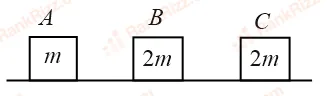
Three objects , and are kept in a straight line on a frictionless horizontal surface. The masses of , and are , and respectively. moves towards with a speed of 9 m s and makes an elastic collision with it. Thereafter makes a completely inelastic collision with . All motions occur along the same straight line. The final speed of is:

6 m s
9 m s
4 m s
3 m s
The initial mass of a rocket is 1000 kg. Calculate at what rate the fuel should be burnt so that the rocket is given an acceleration of 20 m s. The gases come out at a relative speed of 500 m s, with respect to the rocket: [Use m s]
10 kg s
60 kg s
500 kg s
kg s
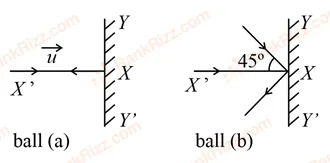
Two billiard balls of equal mass 30 g strike a rigid wall with same speed of 108 kmph (as shown) but at different angles. If the balls get reflected with the same speed, then the ratio of the magnitude of impulses imparted to ball a and ball b by the wall along X direction is:

1 : 1
: 1
2 : 1
1 :
An object of mass collides with another object of mass , which is at rest. After the collision the objects move with equal speeds in opposite direction. The ratio of the masses is :
3 : 1
2 : 1
1 : 2
1 : 1
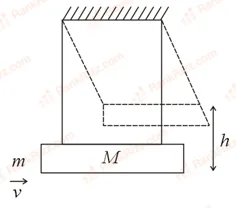
A large block of wood of mass kg is hanging from two long massless cords. A bullet of mass g is fired into the block and gets embedded in it. The (block + bullet) then swing upwards, their center of mass rising a vertical distance cm before the (block + bullet) pendulum comes momentarily to rest at the end of its arc. The speed of the bullet just before the collision is: (Take m s)

841.4 m s
811.4 m s
831.4 m s
821.4 m s
A body of mass moving at speed collides elastically with a mass at rest. After the collision, the two masses move at angles and with respect to the initial direction of motion of the body of mass . The largest possible value of the ratio , for which the angles and will be equal, is:
3
4
2
1
A block moving horizontally on a smooth surface with a speed of 40 m s splits into two parts with masses in the ratio of 1 : 2. If the smaller part moves at 60 m s in the same direction, then the fractional change in kinetic energy is:
Two solids and of mass 1 kg and 2 kg respectively are moving with equal linear momentum. The ratio of their kinetic energies will be , so the value of will be ______.
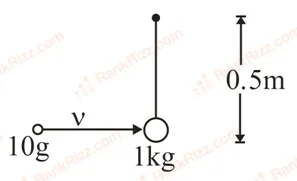
A bullet of 10 g, moving with velocity , collides head-on with the stationary bob of a pendulum and recoils with velocity 100 m s. The length of the pendulum is 0.5 m and mass of the bob is 1 kg. The minimum value of in m s, so that the pendulum describes a circle. (Assume the string to be inextensible and g = 10 m s)

OTHER PHYSICS CHAPTERS