JEE Main 2020 Physics question — Centre of mass of continuous bodies and cavities
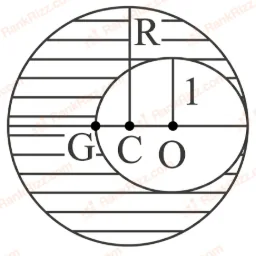
As shown in figure. When a spherical cavity (centred at O) of radius 1 is cut out of a uniform sphere of radius R (centred at C), the centre of mass of remaining (shaded part of sphere is at G, i.e., on the surface of the cavity. R can be determined by the equation:
SOLUTION
Let us denote the uniform mass-density of the material by .
We first write the masses of the two spheres explicitly. For the big sphere (centre at , radius )
and for the cavity (centre at , radius )
The mass of the remaining (shaded) solid is therefore
Because the situation is completely symmetrical about the straight line , the centre of mass of the remainder must lie somewhere on this very line. We choose the origin of the one-dimensional coordinate axis at and measure every distance along as positive. With this choice
The point , by statement of the problem, is situated on the surface of the cavity, that is exactly one unit away from along the same line, so
Now we invoke the centre-of-mass formula for a composite body:
Substituting the known quantities, we have
All common factors cancel immediately, leaving the simple relation
Up to this point, every value of would merely give a different permissible separation of the two centres. However, the drawing that accompanies the question shows the cavity touching the outer surface of the large sphere at a single point. For two spheres of radii (big) and (cavity) this “tangential” condition means quite simply
Putting this geometric condition together with the mass-balance condition just obtained we write
Rearranging,
We still have the factor on the right. It is convenient to eliminate it by first observing from an earlier step that
Dividing both members of this identity by (with ) we get the well-known algebraic result
Substituting this expression for in the equation leads directly to
Exactly the same algebra appears, term for term, in option A, viz.
Hence, the correct answer is Option A.
Tagged Centre of mass of continuous bodies and cavities. Machine-assigned, so read it as a strong shortlist rather than a verdict.