JEE Main 2023 Physics question — Head-on collisions and coefficient of restitution
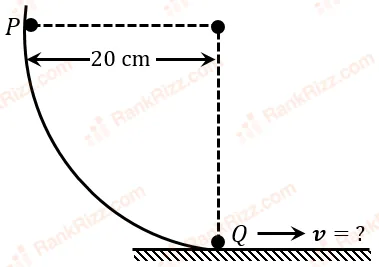
As per the given figure, a small ball slides down the quadrant of a circle and hits the other ball of equal mass which is initially at rest. Neglecting the effect of friction and assume the collision to be elastic, the velocity of ball after collision will be: ( m s)
SOLUTION
Given:
Mass of both balls = equal
Radius of quarter circle = 20 cm = 0.2 m
Initial velocity of ball P=0 (starts from rest)
Initial velocity of ball Q=0(at rest)
Acceleration due to gravity m s
Collision is perfectly elastic
Friction is neglected
A small ball P starts from rest and slides down a smooth quarter circular path. Since friction is neglected, mechanical energy is conserved during the motion.
As the ball moves from the top point to the bottom, it loses gravitational potential energy which gets converted into kinetic energy.
Initial P.E of the ball P =
Final K.E of the ball is
As both should be equal,
=
At the lowest point, the velocity of the ball is horizontal. The ball then collides elastically with another ball Q of equal mass which is initially at rest.
and
Since the collision is perfectly elastic and the masses are equal, the velocities are exchanged after collision.
Thus, after collision, ball P comes to rest and ball Q moves with the velocity that ball P had just before collision.
and
Hence, the required velocity of ball Q is m s
Tagged Head-on collisions and coefficient of restitution. Machine-assigned, so read it as a strong shortlist rather than a verdict.