JEE Main 2021 Physics question — Head-on collisions and coefficient of restitution
Three objects , and are kept in a straight line on a frictionless horizontal surface. The masses of , and are , and respectively. moves towards with a speed of 9 m s and makes an elastic collision with it. Thereafter makes a completely inelastic collision with . All motions occur along the same straight line. The final speed of is:
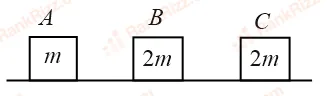
SOLUTION
```html
We need to find the final speed of object after a series of two successive collisions on a frictionless horizontal surface.
1. Identify the Given Parameters
From the problem statement page:
- Mass of object () =
- Mass of object () =
- Mass of object () =
- Initial velocity of () =
- Objects and are initially at rest (, ).
2. First Collision: Elastic Collision Between A and B
Since the collision between and is perfectly elastic (), we can find the final velocity of () immediately after this impact using the standard 1D elastic collision formula:
Since , the second term drops out. Substituting the mass values:
3. Second Collision: Completely Inelastic Collision Between B and C
After the first collision, moves toward with a speed of . When collides with , they stick together because the collision is completely inelastic.
Applying the principle of conservation of linear momentum for this pair:
Since was at rest (), the equation becomes:
Solving for the combined final velocity ():
Conclusion
The final speed of object is 3 .
Tagged Head-on collisions and coefficient of restitution. Machine-assigned, so read it as a strong shortlist rather than a verdict.