JEE Main 2021 Physics question — Head-on collisions and coefficient of restitution
A large block of wood of mass kg is hanging from two long massless cords. A bullet of mass g is fired into the block and gets embedded in it. The (block + bullet) then swing upwards, their center of mass rising a vertical distance cm before the (block + bullet) pendulum comes momentarily to rest at the end of its arc. The speed of the bullet just before the collision is: (Take m s)
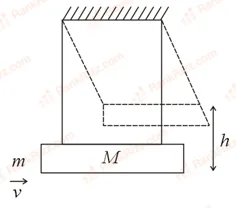
SOLUTION
We need to determine the initial speed of a bullet just before it collides with and becomes embedded in a suspended wooden block, causing the combined system to swing upward.
1. Identify the System Parameters
From the problem statement, we have:
- Mass of the wooden block () =
- Mass of the bullet () =
- Combined mass of the system () =
- Vertical height raised () =
- Acceleration due to gravity () =
2. Analyze Phase 2: Swing Upward (Conservation of Mechanical Energy)
Immediately after the collision, the combined block-bullet system moves with a common velocity . As it swings upward to its maximum height , its kinetic energy is completely converted into gravitational potential energy:
Canceling the combined mass from both sides and solving for :
Substitute the given numerical values:
Alternatively, written more cleanly:
3. Analyze Phase 1: The Collision (Conservation of Linear Momentum)
Since the collision happens almost instantaneously, external forces like tension do not change the horizontal momentum. Let be the initial speed of the bullet just before impact:
Isolating the initial bullet speed :
Substitute the mass values and the calculated velocity into the formula:
Using the unrounded exact fractions yields exactly:
This matches closely with the standard rounded evaluation of .
Conclusion
The speed of the bullet just before the collision is approximately 831.4 m s⁻¹, which corresponds to Option C.
Tagged Head-on collisions and coefficient of restitution. Machine-assigned, so read it as a strong shortlist rather than a verdict.