JEE Main 2021 Physics question — Motion of centre of mass, momentum conservation and explosions
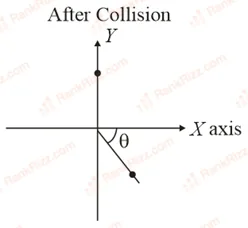
A ball of mass 10 kg moving with a velocity m s along -axis, hits another ball of mass 20 kg which is at rest. After the collision, the first ball comes to rest and the second one disintegrates into two equal pieces. One of the pieces starts moving along -axis at a speed of 10 m s. The second piece starts moving at a speed of 20 m s at an angle (degree) with respect to the -axis. The configuration of pieces after the collision is shown in the figure. The value of to the nearest integer is ________.
SOLUTION
We need to find the value of the angle to the nearest integer after a collision between two balls.
Let the first ball have mass and initial velocity along the -axis .
The second ball has mass and is initially at rest, so .
The total initial momentum of the system along the -axis is: .
The total initial momentum of the system along the -axis is: .
After the collision, the first ball comes to rest (). The second ball disintegrates into two equal pieces of mass each.
The first piece moves along the positive -axis at a speed of . Its momentum vector is: .
The second piece moves at a speed of at an angle below the -axis. Its momentum components are: and .
According to the law of conservation of linear momentum along the -axis: .
Substituting the values gives: , which simplifies to: .
According to the law of conservation of linear momentum along the -axis: .
Substituting the values gives: , which simplifies to: .
From both conditions, we find that: .
Therefore, the value of to the nearest integer is 30.
Tagged Motion of centre of mass, momentum conservation and explosions. Machine-assigned, so read it as a strong shortlist rather than a verdict.