JEE Main 2004 Chemistry question — Equivalent weight, n-factor and law of equivalence
To neutralize completely mL of M aqueous solution of phosphorous acid , the volume of M aqueous KOH solution required is
SOLUTION
The trick to this problem lies in understanding the structural formula and the true basicity (n-factor) of phosphorous acid ().
Although it contains three hydrogen atoms, its structure reveals that only the hydrogens bonded directly to an oxygen atom can dissociate in water as ions. The single hydrogen bonded directly to the central phosphorus atom is non-acidic:
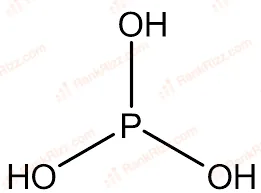
- Therefore, is a dibasic acid ().
- is a strong monacidic base, meaning it releases one ion ().
The stoichiometry reveals that of requires exactly of for complete neutralization.
-
Method: Law of Equivalents
At complete neutralization, the equivalents of acid must equal the equivalents of base:
Since :
-
Substitute the given variables:
- Acid (): , ,
- Base (): , ,
The required volume of the solution is exactly .
Answer: Option C — 40 mL
Tagged Equivalent weight, n-factor and law of equivalence. Machine-assigned, so read it as a strong shortlist rather than a verdict.