JEE Main 2020 Chemistry question — Acidity and basicity of organic compounds
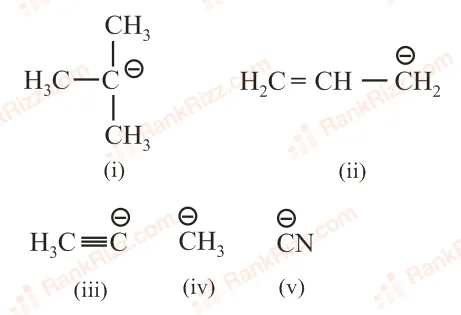
The increasing order of basicity for the following intermediates is (from weak to strong):
SOLUTION
-
Electronegativity and Hybridization:
As the s-character of a carbon atom increases (, , ), its electronegativity increases. A more electronegative atom holds its lone pair of electrons more tightly, making it more stable and less willing to donate them to a proton (less basic). Therefore, basicity follows the order:
-
Inductive Effect ():
Alkyl groups are electron-donating groups via the effect. In carbanions, the presence of electron-donating methyl groups increases electron density on the negative carbon, increasing its tendency to donate electrons and making it highly basic.
Detailed Stability and Basicity Breakdown:
- (Cyanide ion): The negative charge resides on a highly electronegative nitrogen atom, and the carbon is -hybridized. This is exceptionally stable, making it the weakest base.
- (Acetylide ion): The negative charge is on an -hybridized carbon ( s-character). It holds the charge tightly, making it a weak base.
- (Vinyl carbanion): The negative charge is on an -hybridized carbon ( s-character). It is more basic than but less basic than .
- (Methyl carbanion): An -hybridized carbanion ( s-character) with no additional alkyl groups destabilizing it. It is strongly basic.
- (tert-Butyl carbanion): An -hybridized carbanion flanked by three electron-donating methyl groups ( effect). This drastically destabilizes the negative charge, making it the most unstable intermediate and the strongest base.
Conclusion:
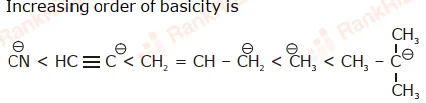
Combining these factors gives the following increasing order of basicity (weak to strong):
Answer: Option C
Tagged Acidity and basicity of organic compounds. Machine-assigned, so read it as a strong shortlist rather than a verdict.