JEE Main 2024 Chemistry question — Distinguishing tests for aldehydes and ketones
Which of the following compound can give positive iodoform test when treated with aqueous solution followed by potassium hypoiodite.
SOLUTION
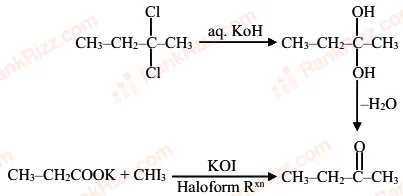
The iodoform test is highly specific for compounds containing either a methyl ketone group () or a secondary methyl alcohol group () that can easily oxidize to a methyl ketone.
When starting with a geminal dihalide complex, treatment with a strong base like aqueous causes nucleophilic substitution to replace the halogen atoms with hydroxyl () groups. If this intermediate step generates a stable or unstable gem-diol that eliminates water to form a methyl ketone structure, it will give a positive iodoform reaction upon adding .
Step-by-Step Analysis of Compound A:
-
Nucleophilic Substitution with Base:
Compound A is 2,2-dichlorobutane (). When treated with aqueous , the two chlorine atoms on carbon-2 are substituted by two hydroxyl groups, forming an unstable gem-diol intermediate:
-
Dehydration to Form a Functional Carbonyl:
Since two hydroxyl groups cannot comfortably sit on the same carbon atom, the intermediate immediately loses a water molecule () to form 2-butanone:
-
Iodoform Conversion:
The resulting 2-butanone contains the required methyl ketone () structural component. When potassium hypoiodite () is added, it undergoes oxidative cleavage to produce a bright yellow precipitate of iodoform () along with a potassium carboxylate salt:
Conclusion:
As clearly depicted in the reaction scheme, 2,2-dichlorobutane converts directly into a methyl ketone intermediate under basic conditions, making it perfectly suited to deliver a positive iodoform response.
Answer: Option A
Tagged Distinguishing tests for aldehydes and ketones. Machine-assigned, so read it as a strong shortlist rather than a verdict.