JEE MAIN 2024 · 09 APR S1+4 / −1MEDIUMTRANSCRIBED
JEE Main 2024 Chemistry question — Nucleophilic addition reactions of carbonyl compounds
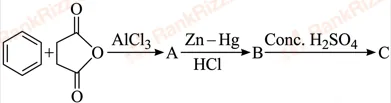
What is the structure of C
SOLUTION
Key idea: Haworth synthesis: Friedel–Crafts acylation with succinic anhydride, then Clemmensen reduction, then intramolecular Friedel–Crafts acylation.
- A (4-oxo-4-phenylbutanoic acid).
- B (4-phenylbutanoic acid). The ketone C=O becomes , and the –COOH stays.
- C: the acylium ion attacks the ring ortho to the side chain and closes a six-membered ring, with loss of .
- So C is α-tetralone (3,4-dihydronaphthalen-1(2H)-one), shown in option (A).
Answer: (A)
Tagged Nucleophilic addition reactions of carbonyl compounds. Machine-assigned, so read it as a strong shortlist rather than a verdict.