JEE Main 2020 Chemistry question — Nucleophilic addition reactions of carbonyl compounds
Consider the following reactions:
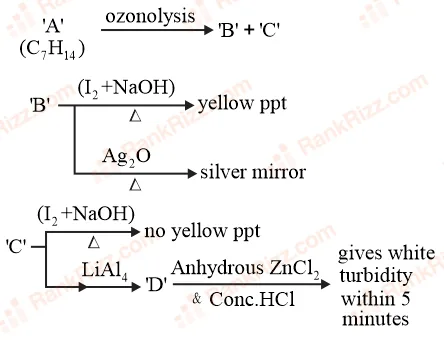
'A' is:
SOLUTION
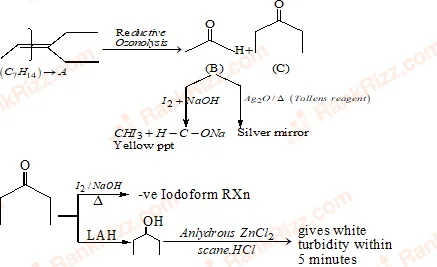
-
Identification of Fragment 'B':
Fragment 'B' is formed via the ozonolysis of compound 'A'. It gives a positive iodoform test (yellow precipitate with ) and a positive Tollens' test (silver mirror with ). This uniquely identifies 'B' as acetaldehyde (), a 2-carbon aldehyde containing a methyl carbonyl group.
-
Deducing the Carbon Count of Fragment 'C':
Since the total molecular formula of 'A' is and ozonolysis cleaves the double bond into two fragments:
-
Identification of Fragment 'C' and 'D':
- 'C' shows a negative iodoform test, indicating it is not a methyl ketone ().
- Reduction of 'C' with () produces alcohol 'D'.
- Alcohol 'D' reacts with Lucas reagent (anhydrous and conc. ) to yield white turbidity within 5 minutes, confirming that 'D' is a secondary () alcohol.
A 5-carbon ketone that is not a methyl ketone must be symmetrical: 3-pentanone (). Its reduction gives 3-pentanol (a alcohol).
-
Reconstructing Compound 'A':
Combining the carbonyl carbons of acetaldehyde () and 3-pentanone () by forming a double bond gives the structure of 'A':
Why Other Structural Options Are Incorrect:
-
Isomers producing Methyl Ketones (e.g., 2-pentanone derivatives):
If compound 'A' were structured to produce 2-pentanone (), fragment 'C' would yield a bright yellow precipitate during the iodoform reaction. This directly contradicts the observed negative test result.
-
Isomers producing Branched Aldehydes:
If fragment 'C' were an aldehyde (such as 2-methylbutanal or 3-methylbutanal), its subsequent reduction with would produce a primary () alcohol. Primary alcohols do not produce turbidity with Lucas reagent at room temperature within 5 minutes, failing to match the experiment.
-
Isomers producing Tertiary Alcohols:
If 'D' were a tertiary () alcohol, it would react with Lucas reagent to produce white turbidity immediately (under 1 minute) rather than taking the characteristic 5 minutes required for secondary alcohol pathways.
Conclusion:
The only structure matching all chemical constraints, including carbon count, functional group classification, and targeted negative/positive tests, is 3-ethylpent-2-ene.
Answer: 3-ethylpent-2-ene
Tagged Nucleophilic addition reactions of carbonyl compounds. Machine-assigned, so read it as a strong shortlist rather than a verdict.