JEE Main 2021 Chemistry question — Nucleophilic addition reactions of carbonyl compounds
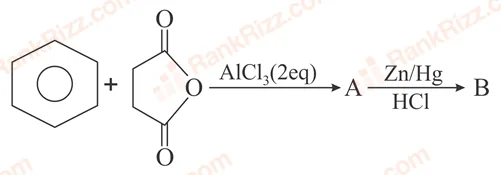
The structures of A and B formed in the following reaction are: Ph = -CH
SOLUTION
The reaction sequence begins with a Friedel-Crafts acylation. Succinic anhydride reacts with the Lewis acid catalyst, , causing the cyclic anhydride ring to open and generate an electrophilic acylium ion. This electrophile attacks the benzene ring, resulting in the formation of an aromatic ketone with a tethered carboxylic acid group. Therefore, compound A is 3-benzoylpropanoic acid, with the structure . Two equivalents of are required for this step because the second equivalent must complex with the newly formed carboxylic acid group to prevent it from deactivating the catalyst.
The second step utilizes zinc amalgam and concentrated hydrochloric acid (, ), which are the standard reagents for a Clemmensen reduction. This reaction specifically targets the ketone carbonyl group, reducing it entirely to a methylene () group while leaving the carboxylic acid functional group completely unaffected. Consequently, the carbonyl group adjacent to the phenyl ring in compound A is reduced. Therefore, compound B is 4-phenylbutanoic acid, with the structure .
These derived structures for compounds A and B exactly correspond to the first given choice.
Correct Option: A
Tagged Nucleophilic addition reactions of carbonyl compounds. Machine-assigned, so read it as a strong shortlist rather than a verdict.