JEE Main 2023 Chemistry question — Nucleophilic addition reactions of carbonyl compounds
Given below are two statements: One is labelled as Assertion A and the other is labelled as Reason R.
Assertion A:
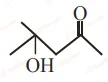
can be easily reduced using Zn Hg/HCl to
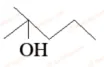
.
Reason R: Zn Hg/HCl is used to reduce carbonyl group to CH group.
In the light of the above statements, choose the correct answer from the options given below:
SOLUTION
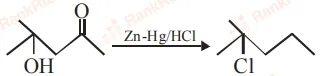
Analysis of Assertion (A):
The reactant provided is a keto-alcohol (contains both a carbonyl group, , and a hydroxyl group, ). When treated with Clemmensen reducing agent (amalgamated zinc and concentrated hydrochloric acid, ), two distinct chemical transformations happen simultaneously:
- Reduction of the Carbonyl Group: The ketone group () is successfully reduced to a methylene group ().
- Substitution of the Hydroxyl Group: Because the reaction happens under highly acidic conditions using concentrated , the secondary alcohol () undergoes a nucleophilic substitution reaction where it is replaced by a chlorine atom ().
Since the final product doesn't accurately shows the carbonyl converted to a alkane linkage and the hydroxyl replaced by chlorine, Assertion A is FALSE.
Analysis of Reason (R):
Reason (R) states that is standardly employed to reduce a carbonyl group down to a active methylene () group. This is the fundamental definition of a Clemmensen reduction, making Reason R perfectly TRUE as an independent chemical statement.
Tagged Nucleophilic addition reactions of carbonyl compounds. Machine-assigned, so read it as a strong shortlist rather than a verdict.