JEE MAIN 2025 · 29 JAN S1+4 / −1MEDIUMTRANSCRIBED
JEE Main 2025 Chemistry question — Nucleophilic addition reactions of carbonyl compounds
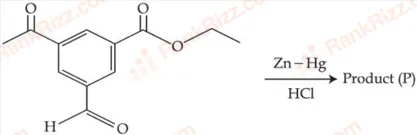
The product (P) formed in the following reaction is :
SOLUTION
Key idea: Clemmensen reduction (Zn–Hg/conc. HCl) reduces aldehyde and ketone carbonyls to /. The C=O of an ester is not reduced.
- The substrate has three carbonyl groups on the ring: an acetyl (), a formyl () and an ethyl ester ().
- Ketone: (ethyl group)
- Aldehyde: (methyl group)
- Ester: unchanged. Clemmensen conditions do not reduce ester carbonyls, and nothing reduces them to alcohols here.
- P = ethyl 3-ethyl-5-methylbenzoate, which is (A).
(B), (C) and (D) contain groups, which would need a hydride reagent such as /.
Answer: (A)
Tagged Nucleophilic addition reactions of carbonyl compounds. Machine-assigned, so read it as a strong shortlist rather than a verdict.