JEE Main 2023 Chemistry question — Nucleophilic addition reactions of carbonyl compounds
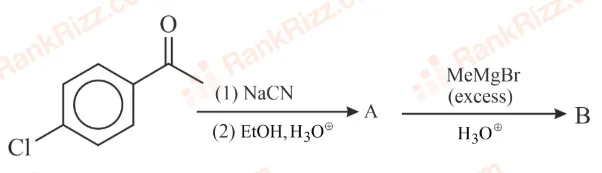
Find out the major products from the following reaction sequence.
SOLUTION

-
Step 1: Cyanohydrin Formation and Alcoholysis (, )
The starting material is a ketone, 4-chloroacetophenone ().
- First, nucleophilic addition of cyanide () to the carbonyl group yields a cyanohydrin intermediate: .
- Second, treating the cyanohydrin with ethanol () under acidic aqueous conditions hydrolyzes and esterifies the nitrile group () into an ethyl ester group ().
This gives the first intermediate shown in the scheme: ethyl 2-(4-chlorophenyl)-2-hydroxypropanoate.
-
Step 2: Grignard Reaction with Excess Methylmagnesium Bromide ( followed by )
The intermediate contains two key functional groups: a tertiary alcohol () and an ester ().
- The first equivalent of the Grignard reagent () acts as a base and deprotonates the acidic hydroxyl proton (), which is later regenerated during acidic workup.
- Another equivalent of undergoes nucleophilic acyl substitution at the ester carbonyl carbon, displacing the ethoxide leaving group () to form a methyl ketone intermediate ().
- Because the Grignard reagent is added in excess, a final equivalent immediately attacks this newly formed ketone group to yield a tertiary alkoxide.
After acidic workup (), the final product contains a highly branched tertiary alcohol unit attached to the original aromatic framework.
Structure of the Final Product:
The carbon atom alpha to the benzene ring preserves its original hydroxyl group () and methyl group (). The ester group () is converted completely into a 2-hydroxypropan-2-yl group ().
Therefore, the structural formula of the final major product is:
Conclusion:
The reaction sequence effectively introduces multiple methyl groups by transforming the ester functionality into a tertiary alcohol while maintaining the structural integrity of the chloro-substituted benzene ring.
Answer: The molecular structure labeled as 'C' in the reaction scheme, which corresponds to .
Tagged Nucleophilic addition reactions of carbonyl compounds. Machine-assigned, so read it as a strong shortlist rather than a verdict.