JEE MAIN 2025 · 28 JAN S1+4 / −1HARDTRANSCRIBED
JEE Main 2025 Chemistry question — Nucleophilic addition reactions of carbonyl compounds
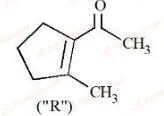
A molecule (" P ") on treatment with acid undergoes rearrangement and gives ("Q"). ("Q") on ozonolysis followed by reflux under alkaline condition gives (" R "). The structure of (" R ") is given below.
The structure of("P")is
SOLUTION
Key idea: Work backwards. R comes from intramolecular aldol condensation of a diketone. That diketone comes from ozonolysis of 1,2-dimethylcyclohexene (Q). Q forms from P by a carbocation rearrangement that expands the ring.
- R → diketone: 1-acetyl-2-methylcyclopentene is the aldol product of octane-2,7-dione, . The enolate at C-3 attacks C-7 and closes a 5-membered ring, and dehydration then gives the conjugated enone.
- Diketone → Q: a 1,6-diketone with methyl ketones at both ends comes from ozonolysis of 1,2-dimethylcyclohexene.
- P → Q: start from (D), 1-isopropylcyclopentan-1-ol, with :
- Loss of gives a 3° cation on the ring carbon.
- A 1,2-H shift from the isopropyl CH gives a 3° cation, , outside the ring.
- A ring bond migrates to it, expanding the ring to a 6-membered (strain-free) ring. The cation is now 2°, next to .
- A 1,2-CH₃ shift gives a 3° cation. Loss of gives 1,2-dimethylcyclohexene.
- (A) is Q itself. (B) has no group that can leave. (C) would expand only to a 5-membered ring, giving a different diketone.
Answer: (D)
Tagged Nucleophilic addition reactions of carbonyl compounds. Machine-assigned, so read it as a strong shortlist rather than a verdict.