JEE Main 2021 Chemistry question — Nucleophilic addition reactions of carbonyl compounds
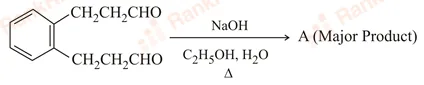
Identify A in the given chemical reaction.
SOLUTION
The reaction undergoes an intramolecular aldol condensation.
The starting compound is a dialdehyde containing acidic -hydrogens adjacent to both aldehyde groups.
In the presence of sodium hydroxide:
one -hydrogen is removed to form a resonance-stabilised enolate ion.
The enolate ion acts as a nucleophile.
Since another aldehyde group is present within the same molecule, intramolecular nucleophilic attack occurs on the second carbonyl carbon.
Because the two side chains are ortho-substituted on the benzene ring, they remain close together, favouring cyclisation.
This forms a new seven-membered ring fused to the benzene ring.
On heating:
the cyclic -hydroxy aldehyde undergoes dehydration.
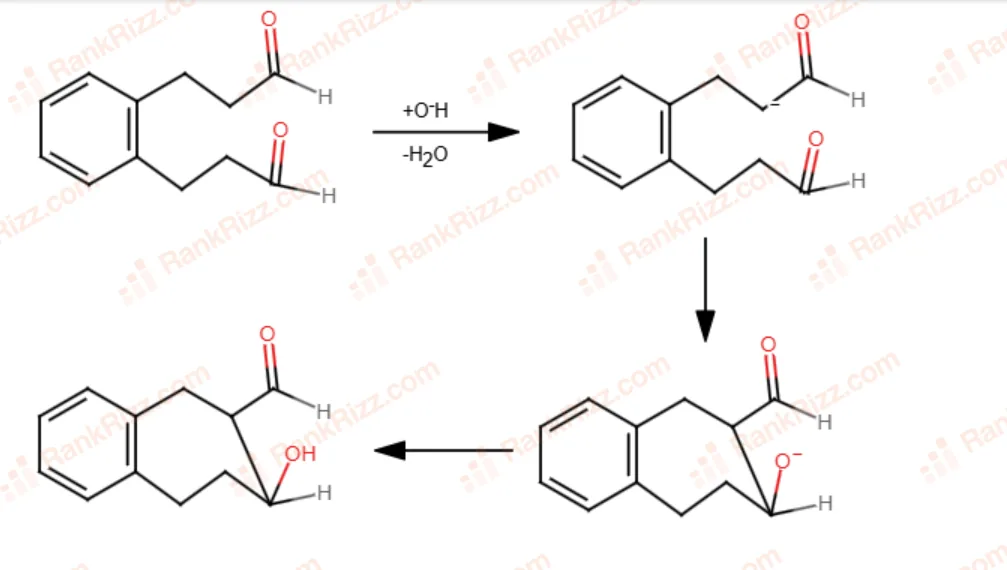
Dehydration of this product gives us the required answer.
The final product contains:
1. A fused seven-membered ring
2. An -unsaturated double bond
3. Conjugation with the remaining aldehyde group
Therefore, the major product is the conjugated cyclic -unsaturated aldehyde.
Tagged Nucleophilic addition reactions of carbonyl compounds. Machine-assigned, so read it as a strong shortlist rather than a verdict.