RankRizz
JEE MAIN 2021 · 24 FEB S2+4 / −1MEDIUMTRANSCRIBED

JEE Main 2021 Chemistry question — Nucleophilic addition reactions of carbonyl compounds

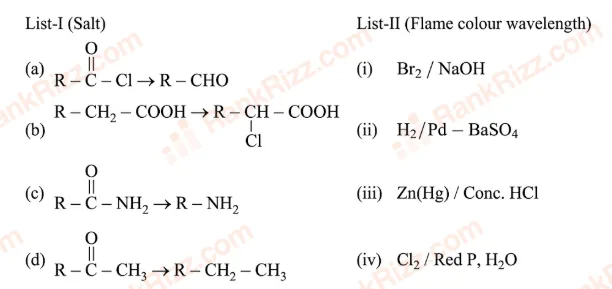
Match List - I with List - II.

Figure for JEE Main 2021 Chemistry question on Nucleophilic addition reactions of carbonyl compounds

Choose the correct answer from the options given below:

SOLUTION

Reaction (a)\mathrm{(a)} converts an acid chloride (RCOCl)\mathrm{(RCOCl)} into an aldehyde (RCHO)\mathrm{(RCHO)}. This reaction is called the Rosenmund Reduction\mathrm{Rosenmund\ Reduction} and uses H2/Pd−BaSO4\mathrm{H_2/Pd-BaSO_4}. Hence, (a)→(ii)\mathrm{(a)\rightarrow(ii)}.

Reaction (b)\mathrm{(b)} involves α\mathrm{\alpha}-halogenation of a carboxylic acid (RCH2COOH→RCH(Cl)COOH)\mathrm{(RCH_2COOH \rightarrow RCH(Cl)COOH)}. This is the Hell-Volhard-Zelinsky Reaction\mathrm{Hell\text{-}Volhard\text{-}Zelinsky\ Reaction} and uses Cl2/Red P, H2O\mathrm{Cl_2/Red\ P,\ H_2O}. Hence, (b)→(iv)\mathrm{(b)\rightarrow(iv)}.

Reaction (c)\mathrm{(c)} converts a primary amide (RCONH2)\mathrm{(RCONH_2)} into a primary amine (RNH2)\mathrm{(RNH_2)} with loss of one carbon atom. This is the Hoffmann Bromamide Degradation\mathrm{Hoffmann\ Bromamide\ Degradation} and uses Br2/NaOH\mathrm{Br_2/NaOH}. Hence, (c)→(i)\mathrm{(c)\rightarrow(i)}.

Reaction (d)\mathrm{(d)} reduces a ketone carbonyl group (RCOCH3)\mathrm{(RCOCH_3)} into RCH2CH3\mathrm{RCH_2CH_3}. This is the Clemmensen Reduction\mathrm{Clemmensen\ Reduction} and uses Zn(Hg)/Conc. HCl\mathrm{Zn(Hg)/Conc.\ HCl}. Hence, (d)→(iii)\mathrm{(d)\rightarrow(iii)}.

Therefore, the correct matching is (a)→(ii), (b)→(iv), (c)→(i), (d)→(iii)\mathrm{(a)\rightarrow(ii),\ (b)\rightarrow(iv),\ (c)\rightarrow(i),\ (d)\rightarrow(iii)}.

Correct Option: A\mathrm{A}

Tagged Nucleophilic addition reactions of carbonyl compounds. Machine-assigned, so read it as a strong shortlist rather than a verdict.

SubjectChemistry
TopicNucleophilic addition reactions of carbonyl compounds
TypeMultiple choice