JEE Main 2025 Chemistry question — Nucleophilic addition reactions of carbonyl compounds
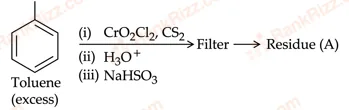
Residue (A) + HCl (dil) Compound (B) Structure of residue (A) and Compound (B) formed respectively is :
SOLUTION
During the alkaline hydrolysis (saponification) of ethyl acetoacetate, the ester group is converted into its sodium salt while ethanol is set free.
Reaction:
After the reaction mixture is boiled, the volatile ethanol distils off. On evaporating the remaining liquid to dryness, the solid that remains is the sodium salt of acetoacetic acid.
Hence (sodium acetoacetate)
When this residue is subsequently treated with dilute hydrochloric acid, simple proton exchange takes place to give the free β-keto-acid (acetoacetic acid) and sodium chloride.
Therefore (acetoacetic acid)
Both structures together correspond to Option D.
Final answer: Option D which is: Residue (A) - sodium acetoacetate () and Compound (B) - acetoacetic acid ().
Tagged Nucleophilic addition reactions of carbonyl compounds. Machine-assigned, so read it as a strong shortlist rather than a verdict.