JEE Main 2012 Chemistry question — Oxidation and reduction of carbonyl compounds
In the given transformation, which of the following is the most appropriate reagent?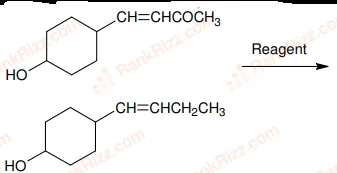
SOLUTION
The conversion shown in the problem corresponds to a COMPLETE removal of the carbonyl oxygen of an aldehyde/ketone, giving an alkane (i.e. overall ). Such a de-oxygenation is called carbonyl reduction to the methylene stage.
There are only two name reactions routinely used for this purpose:
1. Wolff-Kishner reduction: (basic medium).
2. Clemmensen reduction: (strongly acidic medium).
Which one should be chosen depends on the stability of the substrate in acid or base. Because the question explicitly lists both reagents, we must decide which is the “most appropriate” under general conditions. If the molecule contains acid-sensitive functionalities (e.g. -CN, -NO2, -OCOCH3, etc.), the strongly acidic Clemmensen conditions would lead to side reactions or destruction of those groups. Basic Wolff-Kishner conditions avoid that problem and therefore are preferred in most competitive multiple-choice settings.
Thus, the reduction is best carried out with hydrazine followed by strong base (Wolff-Kishner reduction).
Therefore, the correct reagent set is:
Option A which is:
Tagged Oxidation and reduction of carbonyl compounds. Machine-assigned, so read it as a strong shortlist rather than a verdict.