JEE Main 2021 Chemistry question — Nucleophilic addition reactions of carbonyl compounds
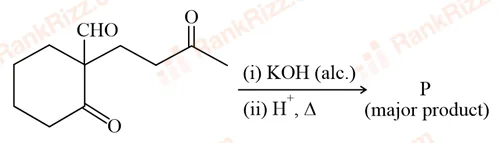
The major product (P) in the following reaction is:
SOLUTION
To determine the major product of this reaction, we first identify the reactive sites present in the starting compound.
The given molecule is a tri-carbonyl compound containing a cyclohexanone ring. The carbon adjacent to the ketone group of the ring is a quaternary carbon attached to:
1. An aldehyde group
2. A side chain containing a methyl ketone
Step 1: Formation of the Enolate Ion
Alcoholic potassium hydroxide acts as a base and removes an acidic alpha-hydrogen to generate an enolate ion.
Among the available alpha-hydrogens, deprotonation occurs preferentially at the terminal methyl group of the side chain because it is less sterically hindered and forms a stable enolate.
Step 2: Intramolecular Aldol Condensation
The generated enolate undergoes intramolecular nucleophilic attack on the aldehyde carbonyl group.
Aldehydes are more reactive than ketones because they possess less steric hindrance and fewer electron-donating alkyl groups.
Thus, the enolate attacks the aldehyde carbonyl carbon selectively.
This intramolecular cyclisation forms a new six-membered ring.
Since the newly formed ring and the original cyclohexanone ring share only one common carbon atom, the product obtained is a spiro compound.
Step 3: Dehydration
Under acidic conditions and heat, the beta-hydroxy ketone undergoes dehydration.
A molecule of water is eliminated, producing an alpha,beta-unsaturated ketone.
The elimination occurs between:
1. The hydroxyl group formed from the aldehyde carbonyl
2. A neighbouring hydrogen atom on the attacking carbon
This produces a conjugated double bond, increasing the stability of the final product.
Overall Transformation:
Final Major Product:
The final major product is a derivative consisting of:
1. The original cyclohexanone ring
2. A newly formed cyclohex-2-en-1-one ring
Both rings are connected through a single spiro carbon atom.
The newly formed ring contains an -unsaturated ketone system, making the final product highly stabilised through conjugation.
Tagged Nucleophilic addition reactions of carbonyl compounds. Machine-assigned, so read it as a strong shortlist rather than a verdict.