JEE MAIN 2020 · 02 SEP S1+4 / −1MEDIUMTRANSCRIBED
JEE Main 2020 Chemistry question — Nucleophilic addition reactions of carbonyl compounds
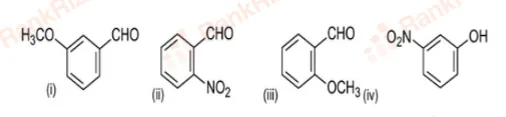
The increasing order of the following compounds towards HCN addition is:
SOLUTION
The addition of cyanide () from to a carbonyl group () is a nucleophilic addition reaction. The rate of this reaction is driven by two main factors:
- Electronic Factor: Electron-withdrawing groups (via or effects) decrease the electron density on the carbonyl carbon, making it more electrophilic (more positive) and highly reactive toward nucleophiles. Conversely, electron-donating groups (via or effects) make the carbon less positive and less reactive.
- Steric Factor: Bulky groups positioned near the carbonyl carbon physically block the approach of the incoming nucleophile, slowing down the reaction.
Detailed Analysis of the Compounds:
-
Compound (ii): 2-Nitrobenzaldehyde
- The nitro group () is a powerful electron-withdrawing group via both inductive () and resonance () effects.
- When placed at the ortho-position, its proximity maximizes the electron-withdrawing impact on the aldehyde carbon, making it exceptionally electrophilic and the most reactive compound in the set.
-
Compound (iv): 3-Nitrobenzaldehyde
- Here, the electron-withdrawing nitro group () is at the meta-position. At this position, it can only exert its weaker inductive () effect, not its resonance () effect.
- It is more reactive than benzaldehyde due to the effect, but significantly less reactive than the ortho-isomer.
-
Compound (i): 4-Methoxybenzaldehyde (Anisaldehyde)
- The methoxy group () is at the para-position. While it is inductively electron-withdrawing (), its strong lone-pair delocalization creates a dominant electron-donating resonance effect ().
- This increases electron density at the carbonyl carbon, reducing its electrophilic character and making it less reactive than unsubstituted benzaldehyde.
-
Compound (iii): 2-Methoxybenzaldehyde
- The methoxy group () is at the ortho-position. In addition to donating electrons via resonance (), its close proximity creates significant steric hindrance directly next to the incoming nucleophile.
- The combination of electronic donation and heavy steric crowding makes it the least reactive compound in the entire group.
Conclusion:
Combining these observations, the reactivity increases from the sterically hindered electron-rich system to the electron-deficient nitro system:
Answer: Option C — (iii) < (i) < (iv) < (ii)
Tagged Nucleophilic addition reactions of carbonyl compounds. Machine-assigned, so read it as a strong shortlist rather than a verdict.